How to Grow Taller at 18

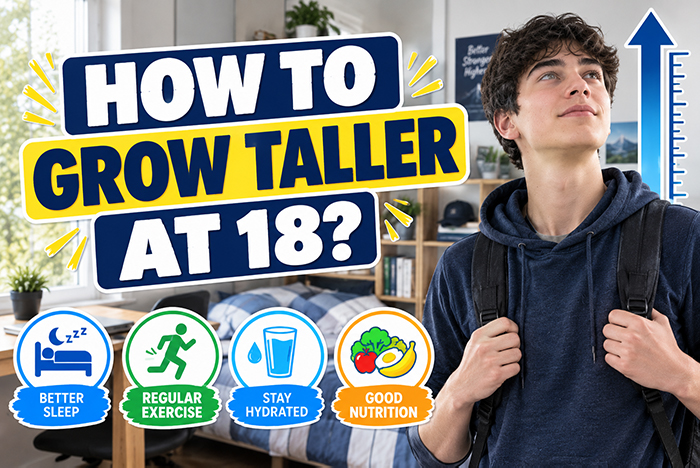
Eighteen is the age when most people start asking whether their growth is truly finished. For many it is — but not for everyone, especially late-maturing young men. Here's an honest look at how much growth is realistically left at 18, what still genuinely matters for your height and bones, and which "grow taller fast" claims to ignore.
Quick Answer
At 18, most people are at or very close to their adult height — but a small amount of growth is still possible if the growth plates haven't fully closed. This is more common in young men who went through puberty later. If any growth remains, the same basics still apply: enough protein, calcium, and vitamin D, 8 to 10 hours of sleep, and regular activity. Once the growth plates have fused, no food, supplement, or exercise can lengthen bones. What you can still do is stand at your full height through good posture and build the strongest bones possible for the decades ahead.
What's Happening at Age 18
Height growth happens at the growth plates — areas of cartilage near the ends of long bones. Toward the end of puberty, rising sex hormones cause these plates to harden and fuse into solid bone, and once that happens, bones can no longer grow in length. The timing depends mostly on when puberty started, which is why two 18-year-olds can be at very different points. For a full explanation, see our guide to growth plates and height development.
Because puberty usually starts earlier, most young women have already reached their adult height by 18. Any further change is typically minimal.
Most are at or near adult height, but late bloomers may still gain a small amount — usually well under an inch — before their growth plates fully close.
If you're wondering what happens a year from now, our article Can You Grow Taller After 19? covers the next stage in more detail.
Average Height and Remaining Growth at 18
CDC growth chart data shows that median height curves are nearly flat by 18. For young women, the curve barely moves after this point, while young men's median height rises by less than an inch between 18 and 20.[1] In other words, for the average person, most growth is already behind them.
That daily variation, measured in a study of spinal loading, is larger than many people realize.[2] It's also why a "growth" of half an inch between a morning and an evening measurement usually isn't growth at all. To track real changes, measure at the same time of day — see how to measure height correctly or try our Height Measurement Accuracy Checker.
What Still Helps: Nutrition
Even when height growth is nearly done, your skeleton is still building density. The recommended calcium intake stays at 1,300 mg per day through age 18.[3] Peak bone mass — the strongest your bones will ever be — is typically reached in the early 20s, and a major review estimates that lifestyle choices influence 20 to 40 percent of it.[4] Good nutrition at 18 supports any growth that remains and protects your height for later in life.
What Still Helps: Sleep
The largest growth hormone pulses happen during deep sleep, and that hormone continues to support bone and tissue repair after growth ends.[5] The American Academy of Sleep Medicine recommends 8 to 10 hours per night for ages 13 to 18.[6] At 18, between exams, jobs, and late nights, that target often slips. Sleep is also when spinal discs rehydrate, which is part of why you're tallest first thing in the morning. See how sleep affects height growth for practical tips.
What Still Helps: Movement and Posture
Exercise won't lengthen bones once the growth plates have closed, but it does two useful things at 18. Weight-bearing and resistance exercise help build bone density toward that early-20s peak. A strong core and back also help you stand at your true height instead of losing it to slouching — long hours at desks and on phones can make anyone look shorter than they are. See the relationship between posture and height, along with yoga poses and weightlifting guides for safe, effective routines.
What to Avoid
Be skeptical of anything promising to add inches after puberty. Products claiming to "reopen" growth plates, stretching devices that promise permanent height, and unprescribed growth hormone are not safe or proven ways to grow taller. Growth hormone is a prescription medication for specific diagnosed conditions, not a height booster for healthy adults.
Our article on height increase myths breaks down the most common claims. For the only medical procedure that can increase adult bone length, read our overview of limb lengthening surgery, including its serious risks and recovery time.
When to Talk to a Doctor
If you want to know whether any growth is left, a doctor can order a bone age X-ray of the hand and wrist to see whether the growth plates are still open. Our Bone Age Calculator and Mid-Parental Height Calculator are useful educational tools, but they don't replace that clinical assessment.
FAQs
Can you still grow taller at 18?
How do I know if my growth plates are closed?
Does stretching or hanging make you taller at 18?
Do height growth supplements work after 18?
How can I look taller at 18?
References
- [1] Kuczmarski RJ, Ogden CL, Guo SS, et al. 2000 CDC growth charts for the United States: methods and development. Vital and Health Statistics, Series 11. 2002;(246):1-190.
- [2] Leatt P, Reilly T, Troup JG. Spinal loading during circuit weight-training and running. British Journal of Sports Medicine. 1986;20(3):119-124.
- [3] National Institutes of Health, Office of Dietary Supplements. Calcium: Fact Sheet for Health Professionals.
- [4] Weaver CM, Gordon CM, Janz KF, et al. The National Osteoporosis Foundation's position statement on peak bone mass development and lifestyle factors: a systematic review and implementation recommendations. Osteoporosis International. 2016;27(4):1281-1386.
- [5] Van Cauter E, Plat L, Copinschi G. Interrelations between sleep and the somatotropic axis. Sleep. 1998;21(6):553-566.
- [6] Paruthi S, Brooks LJ, D'Ambrosio C, et al. Recommended amount of sleep for pediatric populations: a consensus statement of the American Academy of Sleep Medicine. Journal of Clinical Sleep Medicine. 2016;12(6):785-786.