Debunking Common Myths About Height Increase

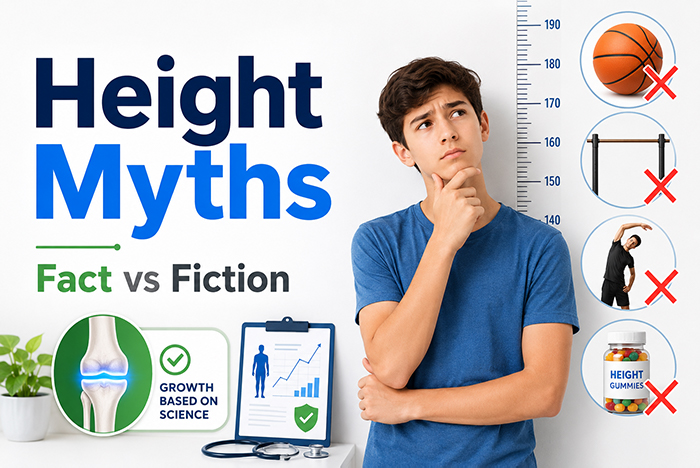
Search "how to get taller" and you will find hanging bars, height-increase gummies, basketball drills, and stretching routines all promising real, added inches. Almost none of it holds up against the actual biology of how bones lengthen. This guide goes myth by myth — separating what genuinely has a sliver of evidence behind it from what is pure marketing, and explaining the one biological fact that makes most of these claims impossible once it applies: the growth plate.
Key Takeaways
- Once growth plates fuse at the end of puberty, no food, supplement, exercise, or stretching routine can add real skeletal height — this is a hard biological ceiling, not a marketing gap.
- Genetics account for roughly 80% of the variation in adult height between people, based on large twin studies — environment and habits explain the rest, and mostly only matter before growth plates close.
- Some myths contain a small grain of truth: milk and dairy show a modest, real effect on childhood growth (largely by closing nutritional gaps), and posture or spinal decompression can add a temporary centimeter or two that disappears within a day.
- Growth hormone injections are approved for specific medical conditions and add only a modest amount of height even then — they are not a general-purpose height booster for otherwise healthy children or adults.
- For the biology of how the growth window actually works, see our companion pieces on Human Growth Hormone (HGH) and Height and Sleep and Height: What the Research Actually Shows.
Why Height Myths Spread So Easily
Height is one of the most visible physical traits a person has, which makes it an unusually emotional subject — and an easy one to market against. Two patterns explain why these myths keep circulating no matter how many times they are debunked.
Tall teenagers are more likely to play basketball; that does not mean basketball made them tall. Children who drink more milk tend to come from households with generally better nutrition overall. When two things move together, it is tempting — and often wrong — to assume one caused the other.
Bone growth happens quietly over years, with no single moment anyone can point to and say "that is when it worked." That absence of visible proof makes it easy for a supplement, stretch, or routine to take undeserved credit for growth that was always going to happen anyway.
▶ Watch: Myths & Facts — Height Growth in Children (Max Hospital)
Watch on YouTube ↗The Big One: "You Can Still Grow Taller After Your Growth Plates Close"
Nearly every other myth on this list collapses once this fact is understood. Long bones grow in length at the growth plate (epiphyseal plate), a layer of cartilage near each end of the bone. During childhood and puberty, this cartilage keeps producing new cells that gradually turn into bone, lengthening the bone in the process. At the end of puberty, rising sex hormones cause the growth plate itself to fuse solid and disappear, replaced entirely by bone. Once that happens, the mechanism that makes bones longer is physically gone — there is no cartilage left to convert.
These are population averages, not fixed deadlines — timing depends on individual pubertal progression, which is why a bone age X-ray, not a birthday, is the only way to know a specific child's actual status.
This is exactly why any product or routine claiming to add height to an adult is making a biologically impossible promise. What can still change after this point is posture, muscle tone, and spinal alignment — real, but limited to a centimeter or two at most, and unrelated to bone length.
Myth-by-Myth Breakdown
The Sliver of Truth Inside a Few of These Myths
Not every myth is entirely wrong — some are exaggerations of a real, smaller effect. Understanding the actual size of these effects helps explain why they get overstated so easily.
What Actually Determines Adult Height
Large studies comparing identical and fraternal twins have consistently found that genetics account for roughly 80% of the variation in adult height between individuals, with nutrition, overall health, and other environmental factors filling in the remaining share. That is also why parental height is the strongest single predictor available before puberty finishes — we cover how that calculation actually works, along with its real limitations, in our guide to Familial Short Stature. The practical implication is straightforward: good sleep, adequate nutrition, and regular activity during the growing years help a child reach the top of their genetic range — nothing sold online can push them past it.
▶ Watch: Why Can't Everyone Be Tall?
Watch on YouTube ↗❓ Frequently Asked Questions
Is there anything that can add height after growth plates close?
Not to actual bone length. Posture correction and core-strengthening exercises can add a centimeter or so by improving spinal alignment, and spinal decompression can temporarily reverse the height lost to daily compression, but neither changes skeletal length.
Do height-increase supplements have any real effect?
If a child has a genuine gap in protein, calcium, or vitamin D intake, closing that gap through diet or supplementation can support normal growth. Supplementing a diet that is already adequate has not been shown to add extra height on top of that.
Does drinking more milk really make kids taller?
Research shows a real but modest association, and the effect tends to be strongest in children whose diets were previously short on protein and calcium. It is not a way to exceed genetic height potential, but it can help a child reach it.
Should a healthy child take growth hormone to get taller?
No. Growth hormone therapy is intended for children with a diagnosed deficiency or specific medical condition, is prescribed and monitored by a pediatric endocrinologist, and carries real risks. It is not appropriate for a healthy child simply hoping to grow taller.
How can I tell if my child still has growing potential left?
Chronological age alone is not reliable, since pubertal timing varies. A bone age X-ray, interpreted by a pediatrician, gives a much clearer picture of how much growth plate activity remains than guessing from age or current height alone.
📚 References
- Shim KS. Pubertal Growth and Epiphyseal Fusion. Annals of Pediatric Endocrinology & Metabolism. 2015;20(1):8–12. pubmed.ncbi.nlm.nih.gov/25883921
- Jentzsch T, Farshad-Amacker NA, Mächler P, et al. Diurnal T2-Changes of the Intervertebral Discs of the Entire Spine and the Influence of Weightlifting. Scientific Reports. 2020;10(1):14395. pubmed.ncbi.nlm.nih.gov/32873838
- Silventoinen K, Sammalisto S, Perola M, et al. Heritability of Adult Body Height: A Comparative Study of Twin Cohorts in Eight Countries. Twin Research. 2003;6(5):399–408. pubmed.ncbi.nlm.nih.gov/14624724
- Cohen P, Rogol AD, Deal CL, et al. Consensus Statement on the Diagnosis and Treatment of Children With Idiopathic Short Stature. Journal of Clinical Endocrinology & Metabolism. 2008;93(11):4210–4217. pubmed.ncbi.nlm.nih.gov/18782877
- de Beer H. Dairy Products and Physical Stature: A Systematic Review and Meta-Analysis of Controlled Trials. Economics & Human Biology. 2012;10(3):299–309. pubmed.ncbi.nlm.nih.gov/21507728