How to Measure Height Correctly: Step-by-Step Guide

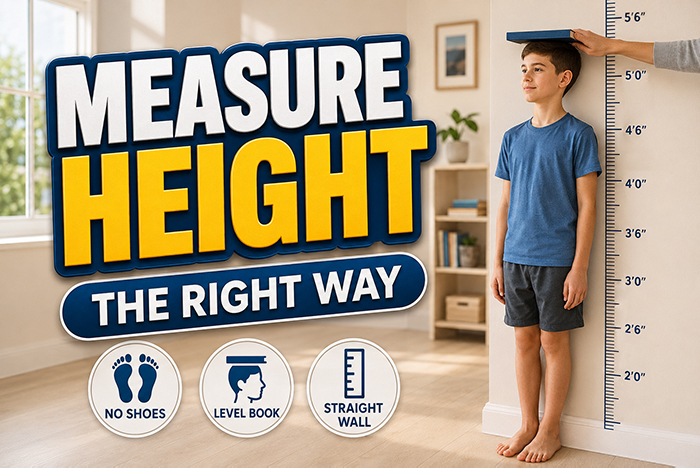
Measure a child's height twice in the same afternoon and you can easily get two different numbers — not because anything is wrong, but because height measurement is far more sensitive to technique than most parents realize. A slouched posture, a measurement taken at the wrong time of day, or comparing a lying-down reading to a standing one can throw off a growth check by a centimeter or more, which is more than enough to make normal growth look worrying (or mask a real problem). This guide walks through the exact technique clinicians use, the most common mistakes that skew home measurements, and how often you actually need to re-measure to track growth meaningfully.
Key Takeaways
- Technique matters more than equipment: a $15 wall-mounted setup used correctly is just as reliable as an expensive clinical stadiometer — the biggest source of error is almost always the person doing the measuring, not the tool.
- Children under 2 (or under about 85 cm) should be measured lying down (recumbent length); children 2 and older are measured standing (stature). The two methods differ by roughly 0.7 cm, which is why growth charts adjust for the switch.
- Height naturally shrinks by roughly 1–2 cm over the course of a day as the spine compresses under gravity, so measuring at a consistent time — ideally morning — keeps comparisons fair.
- A single measurement, however carefully done, isn't precise enough to judge growth on its own. Spacing checks at least 3–6 months apart, using the same method each time, gives a far more reliable picture than back-to-back readings.
- For a quick sanity check on a reading you're unsure about, try our Height Measurement Accuracy Checker, or plot progress over time with the Growth Chart Tracker.
Why Home Height Measurements Are So Often Off
Height looks like the simplest measurement in the world — stand someone against a wall, mark it, done. In practice, it's one of the easiest measurements to get slightly wrong, and small errors compound quickly when you're trying to track a child's growth over months or years. The most common issues aren't equipment failures; they're posture, timing, and consistency problems: measuring at different times of day, letting the head tilt up or down, not fully straightening the knees, or switching between a lying-down measurement and a standing one without accounting for the difference between them. None of these mistakes are obvious just by looking at the number on the tape — they only show up when you compare two readings that should match but don't.
The MethodHow to Measure Standing Height Correctly
▶ Watch: How to Accurately Measure Standing Height — The Wall-Marking Method
Watch on YouTube ↗ Under Age 2Measuring Babies and Toddlers: Lying Down, Not Standing
Children younger than 2 (or shorter than roughly 85 cm) don't stand still or straight enough for an accurate standing measurement, so pediatric guidelines call for recumbent length instead: the child lies flat on their back on a length board, one adult holds the head against a fixed headboard while gently straightening the legs, and a second adult slides a moveable footboard flush against the flexed feet. This method genuinely works better with two people — one at the head, one at the feet — since a squirming baby makes a single-handed measurement unreliable. For more on what's typical at this stage, see Average Height and Weight for Babies and Toddlers.
| Recumbent Length (Under 2) | Standing Height (2 & Older) | |
|---|---|---|
| Position | Lying flat on a length board | Standing against a wall or stadiometer |
| People needed | Two (head + feet) | One, plus a second to read/mark if using a wall |
| Typical reading | About 0.7 cm greater than standing height | About 0.7 cm less than recumbent length |
| If method must switch | Add 0.7 cm if standing height was taken instead | Subtract 0.7 cm if recumbent length was taken instead |
| Growth chart used | WHO length-for-age (0–2 years) | CDC/WHO stature-for-age (2–20 years) |
None of this means home measurements are pointless — it means consistency (same time of day, same method, same surface) matters more than precision to the last millimeter. If you want to track progress over time rather than a single snapshot, the Growth Percentile Calculator and Height Velocity Calculator are built for exactly that.
A Repeatable Measuring Routine
Turning the technique above into a habit is what actually makes measurements comparable over time. Here's a simple sequence to follow every time:
Morning, shortly after waking and before a lot of walking or sitting, gives the most consistent readings since the spine hasn't compressed yet. Whatever time you choose, keep it the same for every future check.
Use the same wall and floor surface every time. A different room with different flooring or trim can introduce small but real discrepancies between "before" and "after" numbers.
Walk through heels-calves-buttocks-shoulders-head contact and the level eye line before taking the reading. Rushing this step is the single biggest source of home measurement error.
Have the child step away and redo the setup from scratch, then measure again. If the two readings differ by more than about 0.5 cm, repeat once more and use the closest pair.
Write down the date alongside the measurement, either on paper or in a calculator like our Growth Chart Tracker. A running record is what turns individual numbers into a meaningful trend.
Don't Overreact to One Reading
It's easy to panic over a measurement that seems to show no growth — or worse, a drop — between two check-ins that are only weeks apart. In most cases, that gap is simply within the normal range of measurement error and daily height variation described above, not a sign that something has stopped working. What actually matters for tracking a child's growth is the trend across several measurements spaced months apart, taken the same way each time, rather than any single number in isolation. If a child's growth percentile is genuinely shifting downward over multiple visits, or a measurement seems far outside what family history and past growth would predict, that's worth bringing to a pediatrician — not something to try to resolve with a tape measure at home.
Continue Reading
❓ Frequently Asked Questions
What's the most accurate way to measure height at home?
Use a hard floor and a flat, trim-free wall, remove shoes and thick socks, and check five points of contact (heels, calves, buttocks, shoulder blades, head) plus a level eye line before marking. Take two independent readings and use the closer pair; the technique matters far more than how expensive the measuring tool is.
Why does my child measure differently in the morning versus at night?
This is normal. Height typically decreases by roughly 1–2 cm over the course of a day as gravity gradually compresses the spinal discs during standing and sitting, then rebounds overnight while lying down. Measuring at the same time of day — ideally shortly after waking — keeps comparisons consistent.
At what age do you switch from measuring length to measuring height?
Children under 2 years old (or shorter than about 85 cm) are measured lying down as recumbent length. From age 2 onward, children are measured standing as height. The two methods typically differ by about 0.7 cm, which growth charts account for at the transition.
How often should I re-measure my child to track growth?
Spacing measurements at least 3–6 months apart gives a far more reliable picture than back-to-back readings, since normal day-to-day and measurement-to-measurement variation can be large enough to obscure or exaggerate short-term changes. Consistent trends across several visits are what matter, not any single reading.
Do I need expensive equipment to measure height accurately?
No. Studies comparing measuring instruments have found that inexpensive, properly installed height boards perform just as reliably as costly clinical stadiometers, and that briefly trained measurers can match experienced ones. Careful, consistent technique is what drives accuracy, not the price of the tool.
📚 References
- Tyrrell AR, Reilly T, Troup JD. Circadian Variation in Stature and the Effects of Spinal Loading. Spine. 1985;10(2):161–164. pubmed.ncbi.nlm.nih.gov/4002039
- Voss LD, Bailey BJ, Cumming K, Wilkin TJ, Betts PR. The Reliability of Height Measurement (The Wessex Growth Study). Archives of Disease in Childhood. 1990;65(12):1340–1344. pubmed.ncbi.nlm.nih.gov/2270942
- Voss LD, Bailey BJ. Equipping the Community to Measure Children's Height: The Reliability of Portable Instruments. Archives of Disease in Childhood. 1994;70(6):469–471. pubmed.ncbi.nlm.nih.gov/8048813
- Ulijaszek SJ, Kerr DA. Anthropometric Measurement Error and the Assessment of Nutritional Status. British Journal of Nutrition. 1999;82(3):165–177. pubmed.ncbi.nlm.nih.gov/10655963
- Buyken AE, Hahn S, Kroke A. Differences Between Recumbent Length and Stature Measurement in Groups of 2- and 3-y-old Children and Its Relevance for the Use of European Body Mass Index References. International Journal of Obesity. 2005;29(1):24–28. pubmed.ncbi.nlm.nih.gov/15278106