How Sleep Affects Height Growth: The Science Explained

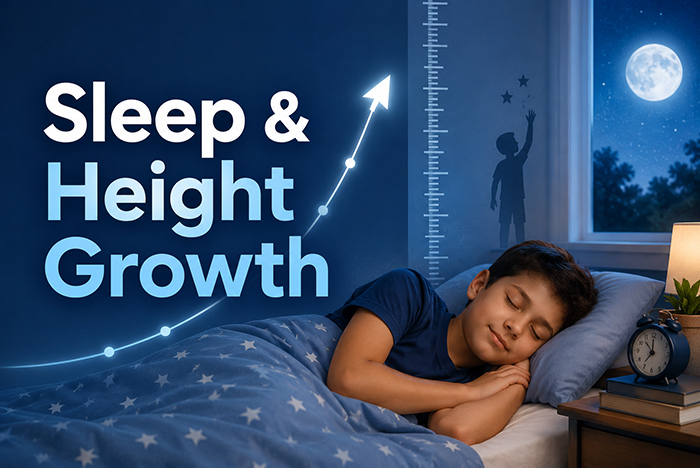
Sleep is often framed as simply the moment when growth hormone (GH) gets released — but that is only one of at least three separate biological pathways connecting sleep to how a child or teen actually grows. This guide looks at the fuller picture: the repair and appetite-hormone mechanisms beyond GH, how widespread sleep deprivation actually is among kids and teens, and the clinical evidence showing that sleep problems like obstructive sleep apnea can measurably stunt growth — and that treating them can restart it.
Key Takeaways
- Sleep supports growth through at least three separate pathways: the GH-IGF-1 endocrine axis, overnight tissue repair and immune regulation, and appetite-hormone balance that shapes next-day eating.
- CDC survey data found 72.7% of U.S. high school students and 57.8% of middle school students report getting less sleep than recommended for their age on an average school night.
- Obstructive sleep apnea and chronic snoring are linked to measurable growth impairment in children — and clinical trials show measurable catch-up growth once the underlying sleep problem is treated.
- Sleep debt accumulates. A single short night has a small effect; weeks or months of shortened sleep during the growing years is where the real impact on growth shows up.
- For the mechanics of the GH pulse itself and a practical nightly routine, see our companion pieces on Human Growth Hormone (HGH) and Height and How to Maximize Growth Hormone Naturally While You Sleep.
Sleep Is Not Just Rest — It Is an Active Growth Process
It is easy to think of sleep as a passive state the body waits through until morning. Physiologically, the opposite is true. Several distinct, measurable processes that directly support growth only happen, or happen most efficiently, during sleep. Missing sleep does not just make a child tired — it interrupts biological work that has no equally effective substitute during waking hours.
▶ Watch: Why Sleep Is So Important for Kids' Growth
Watch on YouTube ↗The endocrine pathway — the overnight pulse of growth hormone that stimulates IGF-1 production — is the most discussed of these, and we cover the mechanism and timing of that pulse in detail in our HGH and Height guide. This article focuses on the other two pathways, which get far less attention but are just as relevant to a child’s growth trajectory.
Sleep is when the body handles cellular repair and immune housekeeping with the least competition from other energy demands. Inflammatory markers that are elevated during illness or chronic stress — particularly C-reactive protein (CRP) — have been shown to correlate inversely with growth in children recovering from sleep-disrupting conditions. In practice, a child who sleeps poorly gets sick more often and recovers more slowly, and both illness and the inflammation that comes with it are known to blunt growth in the short term.
Sleep regulates leptin and ghrelin, the two hormones that govern satiety and hunger. Short or fragmented sleep lowers leptin and raises ghrelin, which increases appetite for calorie-dense, low-nutrient foods the next day. Since consistent protein, calcium, and overall energy intake are themselves required for growth, poor sleep can indirectly undermine growth by disrupting the diet that is supposed to fuel it — a second-order effect that is easy to overlook.
How Widespread Is Sleep Deprivation in Kids and Teens?
Chronic short sleep is not a rare problem confined to a few households with bad habits — it is the statistical norm in the United States. A CDC analysis of the 2015 national Youth Risk Behavior Survey found that a strong majority of school-age children and teens are not getting the sleep recommended for their age group.
The CDC figures come from a nationally representative survey of over 14,000 high school students and combined data from nine states at the middle school level. Short sleep duration was more common among older grades, female students, and varied by state from roughly 62% to 83% of high schoolers depending on region.
When Sleep Problems Become a Medical Growth Issue
Most sleep-related growth impact comes from ordinary sleep debt — late bedtimes, screens, inconsistent schedules. But a smaller group of children have an underlying sleep disorder that can measurably slow growth on its own, independent of any lifestyle habit. Recognizing these is useful context for parents, even though a diagnosis always requires a clinician.
Catch-Up Growth: What Happens After a Sleep Problem Is Treated
The clearest evidence that sleep genuinely drives growth — not just correlates with it — comes from what happens when a sleep-disrupting condition is treated. Several clinical studies have tracked children before and after adenotonsillectomy, the standard surgical treatment for pediatric OSA caused by enlarged tonsils and adenoids.
This does not mean every child who sleeps poorly needs surgery — most sleep-related growth impact in the general population comes from ordinary sleep debt, not diagnosed OSA. But these studies are strong evidence that the sleep-growth link is causal, not just a statistical association.
Sleep Debt Is Cumulative, Not a One-Night Event
One night of short sleep before a big test will not measurably change a child’s growth trajectory. The research above involves sustained sleep disruption over months, sometimes years, before treatment. The practical takeaway is that consistency matters more than any single night: a pattern of going to bed 60–90 minutes later than needed, night after night across a school year, is the kind of exposure that shows up in growth-related research — not an occasional late night. For a night-by-night routine to build that consistency, see How to Maximize Growth Hormone Naturally While You Sleep.
❓ Frequently Asked Questions
Can snoring really affect how tall my child grows?
Frequent, loud snoring can be a sign of obstructive sleep apnea, which has been linked in clinical studies to measurable growth impairment in children. Occasional, quiet snoring during a cold is not the same thing. If snoring is loud, frequent, and accompanied by pauses in breathing, gasping, or very restless sleep, it is worth discussing with a pediatrician.
How do I know if it is sleep apnea or just normal childhood snoring?
Normal snoring is usually occasional, quiet, and tied to congestion or a cold. Signs that warrant evaluation include snoring most nights, witnessed pauses in breathing, gasping or choking sounds, unusually restless sleep, mouth breathing during the day, or daytime sleepiness and behavior changes. A sleep study (polysomnography) is the diagnostic standard — a pediatrician can advise whether one is needed.
How much sleep debt actually causes a problem?
The clinical evidence for growth impairment comes from sustained, chronic sleep disruption — typically months or longer, as seen in children with untreated OSA. A few short nights here and there are not shown to meaningfully affect growth. The concern is a consistent pattern of insufficient sleep sustained over an extended period during the growing years.
Does napping count toward sleep needs for younger children?
Yes. Sleep recommendations for younger children, including the 10–13 hour range for ages 3 to 5, are typically calculated as total sleep across nighttime and naps combined, not overnight sleep alone. As children move into school age, sleep consolidates almost entirely into the overnight period.
If a sleep problem is treated, does growth fully catch up?
Clinical studies show meaningful catch-up growth after treating conditions like pediatric OSA, with some children normalizing their height-for-age within a year or two. Outcomes vary by how long the sleep problem went untreated, the child’s age, and individual factors, so catch-up is common but not universal or guaranteed.
📚 References
- Wheaton AG, Jones SE, Cooper AC, Croft JB. Short Sleep Duration Among Middle School and High School Students — United States, 2015. MMWR Morb Mortal Wkly Rep. 2018;67(3):85–90. cdc.gov/mmwr/volumes/67/wr/mm6703a1.htm
- Paruthi S, Brooks LJ, D’Ambrosio C, et al. Consensus Statement of the American Academy of Sleep Medicine on the Recommended Amount of Sleep for Healthy Children. Journal of Clinical Sleep Medicine. 2016;12(11):1549–1561. pubmed.ncbi.nlm.nih.gov/27707447
- Katz ES, Moore RH, Rosen CL, et al. Growth After Adenotonsillectomy for Obstructive Sleep Apnea: An RCT. Pediatrics. 2014;134(2):282–289. pmc.ncbi.nlm.nih.gov/articles/PMC4187239
- Nachalon Y, Lowenthal N, Greenberg-Dotan S, Goldbart AD. Inflammation and Growth in Young Children with Obstructive Sleep Apnea Syndrome before and after Adenotonsillectomy. International Journal of Pediatrics. 2014;2014:146893. pmc.ncbi.nlm.nih.gov/articles/PMC4158570