Does Protein Help You Grow Taller?

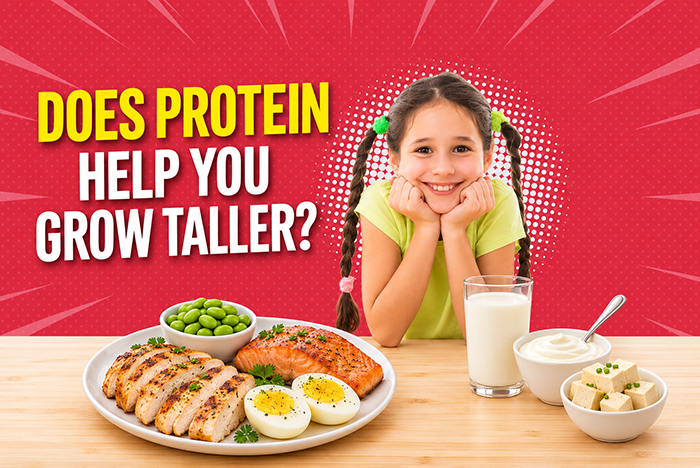
Protein is the nutrient parents mention most when they talk about helping a child grow, and protein shakes for kids are everywhere. It's true that a growing body can't build bone and muscle without it. But "protein is needed for growth" isn't the same as "more protein means more height." Here's what protein actually does for growth, what the research shows about protein and height, how much children really need at each age, and when extra protein helps and when it doesn't.
Quick Answer
Protein helps a child reach their height potential, but it doesn't raise that potential. Protein supplies the building blocks for bone and muscle and helps drive IGF-1, the hormone that does most of the work of lengthening bones at the growth plates.[1]
The biggest benefit is for kids who don't get enough. In a randomized trial of short, lean children aged 3 to 9, a nutritional formula led to more height gain than a placebo over six months.[2] Large studies in well-fed children find only small links between higher protein intake and height.[3][4]
More is not automatically better. Most children already meet their protein needs from everyday food,[6] and very high intake in early childhood is linked to extra weight gain rather than extra height.[7][8]
How Protein Supports Growth
Bones grow longer at the growth plates, layers of cartilage near the ends of the long bones that keep turning into new bone until the end of puberty. That process runs on two things protein provides: raw material, in the form of amino acids for bone matrix, muscle, and other tissues, and a hormonal signal. Adequate protein intake helps maintain levels of insulin-like growth factor 1 (IGF-1), the hormone that carries out most of growth hormone's effects on bone growth.[1]
Broken down into amino acids, including the 9 the body can't make
Adequate protein helps keep growth-factor levels normal
IGF-1 and amino acids support new bone at open growth plates
Enough protein lets growth follow its genetic course; it can't extend it
That last step is the key point. Genetics sets the range for adult height, and protein is one of the conditions that lets a child grow to the top of their own range. Learn more about growth plates and their role in height development and the role of genetics in determining height.
What the Research Shows
Studies on protein and height point in the same direction: protein matters most where intake is low or growth is lagging, and its effect is small in children who already eat well.
| Study | Who was studied | What it found |
|---|---|---|
| Randomized trial, Israel (2014)[2] | 200 short, lean, prepubertal children aged 3 to 9 | A nutritional formula taken for six months led to greater height gain than a placebo. |
| Generation R Study, Netherlands (2016)[3] | 3,564 children followed from age 1 to 9 | Each extra 10 g/day of protein at age 1 was linked to slightly greater height up to age 9, but also to higher weight and BMI. Links were stronger for animal protein. |
| DONALD Study, Germany (2022)[4] | 189 healthy children followed from age 3 into adulthood | In girls, about 7 g/day of protein above recommendations was linked to about 1 cm more adult height. In boys, no effect on adult height was found. |
| Generation R follow-up (2019)[8] | 3,573 children followed from age 1 to 10 | Higher protein intake at age 1 was linked to higher weight, BMI, and fat mass throughout childhood. |
The trial shows cause and effect in a specific group of short, lean children. The cohort studies show associations in general populations, which can't prove that protein itself caused the differences.
Reading the numbers in context: the extra centimeter seen in the DONALD girls was an average, measured in a well-fed population, and the researchers noted no such effect in boys.[4] The Generation R findings showed that higher early protein raised weight and body fat as well as height.[3][8] None of these studies suggests that loading up on protein is a reliable way to make a well-nourished child taller.
For a closer look at protein shakes specifically, including the details of the trial above, see our article on whey protein and height. For the wider role of diet, see the nutrition and height connection.
How Much Protein Kids and Teens Need
The Recommended Dietary Allowance (RDA) is the amount that meets the needs of nearly all healthy people in each age group. Children need more protein per pound of body weight than adults because they are growing.[5]
| Age | RDA (grams per day) | Per kg of body weight |
|---|---|---|
| 1–3 years | 13 g | 1.05 g/kg |
| 4–8 years | 19 g | 0.95 g/kg |
| 9–13 years | 34 g | 0.95 g/kg |
| Girls 14–18 years | 46 g | 0.85 g/kg |
| Boys 14–18 years | 52 g | 0.85 g/kg |
| Adult women / men | 46 g / 56 g | 0.8 g/kg |
Source: Institute of Medicine (now the National Academies) Dietary Reference Intakes.[5] Very active teens and young athletes may need more; a pediatrician or sports dietitian can advise.
The per-kilogram figure is often more useful than the daily total, because children of the same age can differ a lot in size. Our Protein Needs Calculator for Kids & Teens works it out from your child's age and weight in seconds.
▶ Watch: What Are the Daily Protein Needs of Children?
Watch on YouTube ↗Are Most Kids Already Getting Enough?
In the U.S., usually yes. Analyses of national dietary survey data show that average daily protein intake meets or exceeds the RDA across age groups.[6] The German DONALD researchers likewise noted that many children eat considerably more protein than recommended, in some cases 1.7 to 2 times as much.[9]
Those are averages, though, and some children do fall short. The groups most worth a closer look are:
- Very picky eaters who refuse most meat, eggs, dairy, and beans.
- Children on vegetarian or vegan diets without a planned mix of plant proteins. See height-boosting foods for vegetarians.
- Kids with a small appetite or low weight who are also short for their age.
- Teen athletes with high training loads who may need more than the standard RDA.
- Children with a medical condition that affects appetite, digestion, or absorption.
Can Too Much Protein Backfire?
In the first years of life, it can. A large randomized trial found that infants fed a higher-protein formula gained more weight by age 2 than those fed a lower-protein formula.[7] And in the Generation R study, higher protein intake at age 1 was linked to higher body fat that persisted up to age 10.[8] In other words, extra protein beyond a young child's needs tends to show up as extra weight, not extra height.
Watch for "stacking": a child who already drinks milk, eats meat or eggs most days, and snacks on yogurt or cheese can easily exceed their protein needs before adding a protein shake or bar. If you're considering a supplement, add up a typical day's intake first.
For school-age children and teens, moderately high protein from normal food isn't known to be harmful, but there's no evidence that going far above the RDA brings extra growth. The DONALD researchers also pointed out that the long-term effects of habitually high protein intake in children have not been well studied.[9]
Best Protein Foods for Growing Kids
Everyday foods cover most children's needs easily. A glass of milk, an egg, and a small portion of chicken together provide more than the 19 g a day a 6-year-old needs.
| Food | Serving | Protein (approx.) |
|---|---|---|
| Chicken breast, cooked | 3 oz (85 g) | 26 g |
| Salmon, cooked | 3 oz (85 g) | 22 g |
| Greek yogurt, plain | 6 oz (170 g) | 15–17 g |
| Lentils, cooked | ½ cup | 9 g |
| Milk | 1 cup (8 fl oz) | 8 g |
| Cheddar cheese | 1 oz (28 g) | 7 g |
| Peanut butter | 2 tbsp | 7 g |
| Egg | 1 large | 6 g |
Approximate values based on USDA FoodData Central; exact amounts vary by brand and preparation.[10]
- Spread it across the day: children use protein well from small amounts at each meal and snack, so there's no need for a large serving at once.
- Mix animal and plant sources: dairy, eggs, fish, and meat provide all essential amino acids, while beans, lentils, tofu, and nuts add fiber and other nutrients.
- Pair protein with calcium and vitamin D: bones need all three. See the importance of calcium for bone growth and vitamin D and height.
- Don't forget sleep and activity: protein works alongside them, not instead of them. Read how sleep affects height growth.
When to Talk to a Doctor
A pediatrician or registered dietitian can review the growth chart and a typical day's diet to see whether protein, or overall calories, is really the gap. Track growth between visits with our Growth Chart Tracker, and see other common causes in factors that stunt growth in children.
FAQs
Does protein help you grow taller?
How much protein does a child need to grow?
Can eating more protein make a teenager taller?
Is animal or plant protein better for growth?
Do kids need protein powder or shakes?
Can too much protein be harmful for children?
References
- [1] Rogol AD, Clark PA, Roemmich JN. Growth and pubertal development in children and adolescents: effects of diet and physical activity. American Journal of Clinical Nutrition. 2000;72(2 Suppl):521S-528S.
- [2] Lebenthal Y, Yackobovitch-Gavan M, Lazar L, et al. Effect of a nutritional supplement on growth in short and lean prepubertal children: a prospective, randomized, double-blind, placebo-controlled study. The Journal of Pediatrics. 2014;165(6):1190-1193.e1.
- [3] Braun KVE, Erler NS, Kiefte-de Jong JC, et al. Dietary intake of protein in early childhood is associated with growth trajectories between 1 and 9 years of age. The Journal of Nutrition. 2016;146(11):2361-2367. repub.eur.nl/pub/96538
- [4] Hua Y, Remer T. Adult stature and protein intake during childhood and adolescence from 3 years onward. Journal of Clinical Endocrinology and Metabolism. 2022. doi.org/10.1210/clinem/dgac205
- [5] Institute of Medicine. Dietary Reference Intakes for Energy, Carbohydrate, Fiber, Fat, Fatty Acids, Cholesterol, Protein, and Amino Acids. Washington, DC: National Academies Press; 2005. nap.nationalacademies.org/catalog/10490
- [6] National Dairy Council. Protein data brief: protein intake by age, based on NHANES data. 2015. dairy.org
- [7] Koletzko B, von Kries R, Closa-Monasterolo R, et al. Lower protein in infant formula is associated with lower weight up to age 2 y: a randomized clinical trial. American Journal of Clinical Nutrition. 2009;89(6):1836-1845.
- [8] Longitudinal association of dietary protein intake in infancy and adiposity throughout childhood (Generation R Study). Clinical Nutrition. 2019;38(3). doi.org/10.1016/j.clnu.2018.05.013
- [9] University of Bonn. Protein boosts height growth in girls [press release on the DONALD study]. April 7, 2022. uni-bonn.de
- [10] U.S. Department of Agriculture. FoodData Central. fdc.nal.usda.gov