The Relationship Between Posture and Height

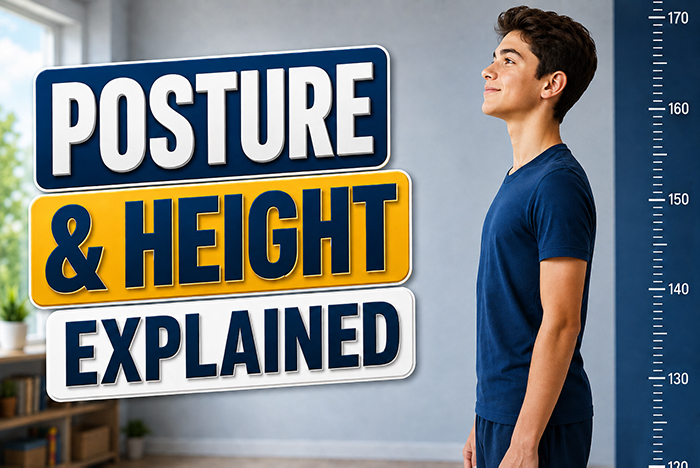
Stand up straight and you can look 2–3 cm taller in seconds — no supplements, no surgery, just squared shoulders and a lifted chest. That's not a trick; it's simple spinal mechanics. Posture doesn't change how tall your bones grow, but it does change how much of that height actually shows up when you're standing (or sitting) in front of someone. For growing kids and teens especially, the habits formed now — hours hunched over phones and desks, heavy backpacks, slouched sitting — can shape spinal alignment for decades. This guide breaks down exactly how posture and height are connected, which everyday habits quietly work against good alignment, and a simple, repeatable routine to build better posture starting today.
Key Takeaways
- Posture doesn't change bone length or growth plates — it changes how upright your existing height is displayed. Slouching, rounded shoulders, and forward head posture can visually "cost" several centimeters without changing a person's true skeletal height at all.
- Over years, however, chronic poor posture can reshape the spine's natural curves. Research on older adults has linked a 15° increase in thoracic curvature (kyphosis) to more than 4 cm of measured height loss — a reminder that posture habits compound over a lifetime.
- Growing kids and teens are especially exposed: studies of school-age children found abnormal spinal curvature in roughly a third to half of students while in typical reading/writing posture at a desk.
- Forward head posture ("tech neck") dramatically increases load on the cervical spine — from about 5 kg in neutral alignment to over 25 kg at a 45–60° forward tilt, the exact posture common during phone and laptop use.
- The good news: posture is trainable. Structured exercise programs have measurably improved forward head and shoulder posture in teenagers within about 16 weeks of consistent practice.
Does Posture Actually Affect Height?
Here's the honest, two-part answer. In the short term, absolutely — posture is the single biggest reason two measurements of the "same" height can differ by a centimeter or more. Rounded shoulders, a collapsed chest, and a forward-tilted head all compress the natural curves of the spine, effectively shortening the vertical distance from floor to the top of the head. Stand tall, engage the core, and pull the shoulders back, and that same person can measure noticeably taller within seconds — nothing about their skeleton changed, only how it's being held.
In the long term, posture doesn't influence how much a growing child's bones lengthen; that's governed by growth plates, genetics, nutrition, and sleep — not by how straight someone sits at a desk. But posture does shape the spine's structure over years. Chronic slouching and a persistently rounded upper back can gradually accentuate thoracic kyphosis (the spine's natural forward curve), and more pronounced curvature is associated with measurable height loss over time; research in older women found that a 15° increase in kyphosis was associated with losing more than 4 cm of height. That's a slow, cumulative process rather than something that happens overnight, but it's exactly why posture habits built in childhood and adolescence matter well beyond how someone looks in a photo.
The CulpritsEveryday Habits That Undermine Good Posture
What Good Posture Actually Looks Like
| Good Posture | Poor Posture | |
|---|---|---|
| Head position | Ears stacked directly over shoulders | Head juts forward, chin leads |
| Shoulders | Relaxed, gently pulled back | Rounded forward, curled inward |
| Upper back | Natural gentle curve, chest open | Exaggerated rounding (hunched) |
| Lower back | Natural inward curve maintained | Flattened or overly arched |
| Sitting habit | Feet flat, back supported, screen at eye level | Perched forward, screen low, back unsupported |
| Standing weight | Evenly distributed on both feet | Shifted onto one hip repeatedly |
None of these numbers mean posture can add true height beyond a person's biological ceiling — but they show posture is a real, trainable factor in how tall someone measures and how their spine ages over time.
▶ Watch: Easy Posture Routine for Kids
Watch on YouTube ↗ Daily RoutineTips for Maintaining Good Posture for Height Growth
Good posture isn't a one-time correction — it's a set of small habits repeated throughout the day. Here's a simple routine to build:
Stand with heels, calves, buttocks, shoulder blades, and head touching a wall. This is neutral posture — step away while trying to hold that same feeling through the day.
Raise laptops and tablets so the top of the screen is roughly at eye height, instead of looking down for hours. This alone removes a major source of forward head posture.
Stand, stretch, or walk briefly after every 30–40 minutes of sitting. Postural muscles fatigue with prolonged static positions — short breaks reset them before slouching sets in.
Simple exercises — planks, wall angels, rows, and chin tucks — build the muscular support that makes holding good posture effortless instead of a constant, tiring correction.
Use both straps, tighten them so the bag sits close to the back, and keep total weight to a reasonable fraction of body weight to avoid pulling the shoulders and spine out of alignment.
Favor back or side sleeping with a supportive pillow that keeps the neck level, rather than stomach sleeping with the head twisted to one side for hours.
What Good Posture Can't Do
It's worth being clear-eyed here: good posture is genuinely valuable for spinal health, appearance, breathing, and long-term comfort — but it will not add centimeters to a child's or teen's biological growth potential. That's determined by genetics, nutrition, sleep, and growth plate activity, topics covered in our guides to Exercise and Its Effect on Height Growth and How Sleep Affects Height Growth. What posture work reliably delivers is making sure that whatever height a person has is fully expressed, rather than partially hidden by a slouch, and protecting the spine from the kind of chronic curvature that causes real height loss later in life. If a child has persistent back pain, visible spinal asymmetry, or one shoulder or hip that sits noticeably higher than the other, that's worth a pediatrician's evaluation for scoliosis rather than something to address with posture exercises alone.
Continue Reading
❓ Frequently Asked Questions
Can bad posture make you shorter?
In the moment, yes — slouching and rounded shoulders compress the spine's natural curves and can make someone measure a centimeter or more shorter than when standing tall. Over years, chronic poor posture can also reshape the spine's curvature in ways linked to real, measurable height loss later in life, though it doesn't affect a growing child's actual growth potential.
Can improving posture make you taller?
Correcting posture won't add height beyond a person's biological ceiling, but it can reveal height that poor posture was hiding — standing tall with proper alignment can make someone appear noticeably taller than when slouching, simply by uncompressing the spine into its natural, upright position.
How does tech neck affect posture?
Looking down at phones and laptops pulls the head forward of the shoulders, which biomechanical models show dramatically increases the load on the neck — from roughly 5 kg in neutral posture to over 25 kg at a 45–60° forward tilt. Sustained over years, this posture pattern contributes to rounded shoulders and an exaggerated upper back curve.
How long does it take to fix posture?
Research on adolescents found measurable improvement in forward head and shoulder posture after about 16 weeks of a consistent, structured exercise program combined with regular physical activity. Daily habits — desk setup, movement breaks, and targeted exercises — matter more than any single stretch or quick fix.
Should parents worry about their child's posture affecting height?
Ordinary slouching from screen time or desk work won't stunt a child's growth, but it's still worth encouraging good habits early since posture patterns tend to persist into adulthood. What does warrant a pediatrician visit is visible spinal asymmetry, persistent back pain, or one shoulder or hip sitting noticeably higher than the other, which can indicate scoliosis rather than ordinary postural slouching.
📚 References
- Ensrud KE, Black DM, Harris F, Ettinger B, Cummings SR. Correlates of Kyphosis in Older Women. The Fracture Intervention Trial Research Group. Journal of the American Geriatrics Society. 1997;45(6):682–687. pubmed.ncbi.nlm.nih.gov/9180660
- Hansraj KK. Assessment of Stresses in the Cervical Spine Caused by Posture and Position of the Head. Surgical Technology International. 2014;25:277–279. pubmed.ncbi.nlm.nih.gov/25393825
- Wen L, Lin X, Li C, Zhao Y, Yu Z, Han X. Sagittal Imbalance of the Spine Is Associated with Poor Sitting Posture Among Primary and Secondary School Students in China: A Cross-Sectional Study. BMC Musculoskeletal Disorders. 2022;23:98. pubmed.ncbi.nlm.nih.gov/35090408
- Ruivo RM, Pezarat-Correia P, Carita AI. Effects of a Resistance and Stretching Training Program on Forward Head and Protracted Shoulder Posture in Adolescents. Journal of Manipulative and Physiological Therapeutics. 2017;40(1):1–10. pubmed.ncbi.nlm.nih.gov/27842938