The Connection Between Weightlifting and Height

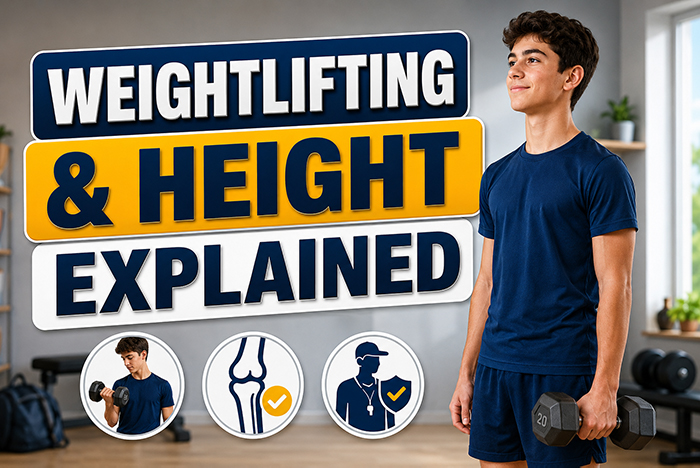
"Don't lift weights, you'll stunt your growth" is one of the most repeated warnings in youth sports — passed from coaches to parents to teens for decades. It's also one of the most thoroughly studied myths in pediatric sports medicine. This guide looks at where the fear actually comes from, what the research on growth plates and youth resistance training really shows, and how weightlifting genuinely connects to height — just not in the way the myth suggests.
Key Takeaways
- The "weightlifting stunts growth" fear traces back to real growth-plate injuries — but those come from poor supervision, poor technique, or maxing out on heavy single lifts, not from resistance training itself.
- The American Academy of Pediatrics, the National Strength and Conditioning Association, and an international sports-medicine consensus all now endorse supervised, age-appropriate resistance training for healthy children and teens.
- No case of a growth-plate fracture has been documented in a properly designed and competently supervised youth resistance-training program.
- Weightlifting doesn't raise a person's genetic height ceiling, but it can support the bone density, posture, and consistency that help someone make the most of the growth window they already have.
- The real risk factors are the same ones that make any youth sport risky — being unsupervised, using bad form, or attempting a single maximum-effort lift — not the presence of weights themselves.
Does Weightlifting Actually Stunt Growth?
Every major pediatric and sports-medicine body that has reviewed the evidence — the American Academy of Pediatrics, the National Strength and Conditioning Association, and a 2014 international consensus panel — has reached the same conclusion: resistance training does not stunt growth in children or teens when it's age-appropriate, technique-focused, and supervised. The fear isn't baseless, though. It's rooted in a real injury — just not the one the myth blames on lifting weights specifically.
The growth plate (physis) is softer cartilage, not solid bone, which makes it a genuinely weaker point in a growing skeleton. That anatomical fact got generalized into a blanket warning against any weight in a child's hands.
A widely cited evidence-based review found no growth-plate fractures reported in youths following a properly prescribed resistance-training program with competent instruction. The injuries that do occur trace to unsupervised lifting, poor form, or single maximum-effort attempts — not structured training.
Both things are true at once: growth-plate injuries are a real and fairly common part of childhood (they show up across all kinds of falls, sports, and accidents), and structured resistance training — done with a light load, correct form, and a coach who knows what they're doing — isn't where those injuries come from.
The ToolkitMaking Resistance Training Safe for Growing Bodies
It Supports the Growth You're Already Set Up For — It Doesn't Add to It
Weightlifting has no documented ability to raise the height a person's genes already determine. What it can do is support the parts of the picture within someone's control: building bone density during the exact years when peak bone mass is being established, reinforcing posture so a teen stands at their full natural height rather than looking shorter through a slouch, and building the kind of consistent training habit that pairs well with the sleep and nutrition height actually depends on. For the full breakdown of how much of height comes down to family genetics versus environment, see our guide to the role of genetics in determining height.
▶ Watch: Does Weight Lifting Stunt Kids' Bone Growth?
Watch on YouTube ↗ The NumbersRead together: growth-plate injuries are common in childhood generally, but the research specifically clears supervised resistance training of causing them; meanwhile, the strength and bone-health benefits of that same training are well documented — they just don't extend to changing adult height.
Bringing Weightlifting Into a Teen's Routine
For a teen who wants to start lifting, the safest path is a program built around bodyweight and light-resistance movements first, ideally with a coach or trainer who works with youth athletes, alongside the fundamentals that actually move the needle on growth. Our guide to the best height growth exercises for teenagers covers a broader mix of activities beyond lifting, and pairing training with enough sleep matters just as much — see how sleep affects height growth for why.
The real red flags to watch for aren't "lifting weights" in general — they're unsupervised training, poor form, and attempting to max out on a single heavy lift, especially overhead. Sharp or persistent pain at a joint line during or after training is different from normal muscle fatigue and warrants stopping the activity and seeing a doctor. Recovery also depends on the basics: adequate protein and calcium intake and enough sleep are what let the body actually adapt to training rather than just accumulate fatigue.
Continue Reading
❓ FAQs
Does weightlifting stunt growth in teenagers?
No credible evidence supports this. Major reviews of the research have found no documented growth-plate fractures in youths following properly supervised, technique-focused resistance-training programs, and organizations including the American Academy of Pediatrics endorse age-appropriate strength training for healthy children and teens.
Is it safe for a young teenager to lift weights?
Generally yes, with the right setup: light loads while learning technique, qualified supervision, and avoiding single maximum-effort lifts. The American Academy of Pediatrics and the National Strength and Conditioning Association both support supervised resistance training for children as young as 7 or 8 when they can follow instructions and maintain balance and form.
What age can kids start strength training?
There's no strict minimum age in the guidelines — readiness matters more than age. Coaches typically look for the ability to follow directions, balance well, and stay disciplined during exercises, which some children reach as early as 7 or 8, using bodyweight movements before any added resistance.
Can lifting weights make someone shorter?
No. Weightlifting doesn't compress or damage the spine or long bones in a way that reduces adult height. The one caveat is that undetected growth-plate injuries from any cause, including poor-form or unsupervised lifting, can in rare cases affect bone growth at that specific site — which is why proper technique and supervision matter.
Does weightlifting help you grow taller?
It doesn't raise the genetic ceiling on adult height, but it supports things that make a real difference within that ceiling: bone density built during the growing years, better posture, and a consistent training habit that pairs well with good sleep and nutrition.
📚 References
- Mizuta T, Benson WM, Foster BK, Paterson DC, Morris LL. Statistical Analysis of the Incidence of Physeal Injuries. J Pediatr Orthop. pubmed.ncbi.nlm.nih.gov/2250054
- Malina RM. Weight Training in Youth-Growth, Maturation, and Safety: An Evidence-Based Review. Clin J Sport Med. 2006;16(6):478–487. pubmed.ncbi.nlm.nih.gov/17119361
- Faigenbaum AD, Kraemer WJ, Blimkie CJ, et al. Youth Resistance Training: Updated Position Statement Paper From the National Strength and Conditioning Association. J Strength Cond Res. 2009;23(5 Suppl):S60–79. pubmed.ncbi.nlm.nih.gov/19620931
- Lloyd RS, Faigenbaum AD, Stone MH, et al. Position Statement on Youth Resistance Training: The 2014 International Consensus. Br J Sports Med. 2014;48(7):498–505. pubmed.ncbi.nlm.nih.gov/24055781
- Stricker PR, Faigenbaum AD, McCambridge TM; AAP Council on Sports Medicine and Fitness. Resistance Training for Children and Adolescents. Pediatrics. 2020;145(6):e20201011. pubmed.ncbi.nlm.nih.gov/32457216
- Behringer M, vom Heede A, Yue Z, Mester J. Effects of Resistance Training in Children and Adolescents: A Meta-Analysis. Pediatrics. 2010;126(5):e1199–e1210. pubmed.ncbi.nlm.nih.gov/20974785
- Silventoinen K, Sammalisto S, Perola M, et al. Heritability of Adult Body Height: A Comparative Study of Twin Cohorts in Eight Countries. Twin Research. 2003;6(5):399–408. pubmed.ncbi.nlm.nih.gov/14624724