The Role of Genetics in Determining Height: What Science Actually Says

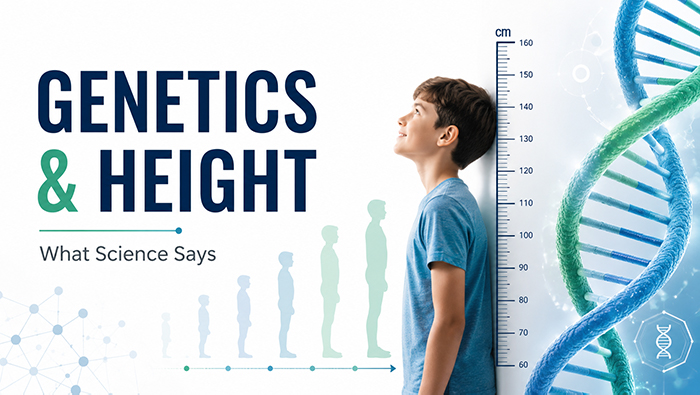
Your child's height is written — at least in part — before they take their first breath. Genetics account for the majority of height variation between individuals, but "majority" is not "all." Understanding what DNA actually controls, and where environment picks up the slack, helps parents make smarter decisions during the years it still matters.
Key Takeaways
- Genetics is estimated to account for roughly 60–80% of height variation between individuals.
- Height is a polygenic trait — hundreds of genes contribute small effects, not one single "tall gene."
- Non-genetic factors — nutrition, sleep, physical activity, and overall health — shape the remaining 20–40%.
- Mid-parental height is a useful but imperfect predictor; children regularly exceed or fall short of it.
- Growth plates close in late adolescence; interventions matter most before that window ends.
How Much of Height Is Actually Genetic?
Twin and family studies consistently put the heritability of height between 60% and 80% in well-nourished populations. Heritability, in the scientific sense, doesn't mean "caused by genes" — it means "the proportion of variation in a population that is explained by genetic differences." In practical terms: if you lined up a hundred children from similar nutritional backgrounds, the majority of the height differences you'd see trace back to their DNA.
That number shifts depending on the environment. In populations where nutrition is limited or inconsistent, environmental factors claim a larger share. In populations with stable, adequate food access and healthcare, genetics dominates more clearly. This is why the same genetic potential can produce different outcomes depending on where and how a child grows up.
Height Is Polygenic — Not One Gene, but Hundreds
For years, researchers hoped to find a handful of "height genes." What large-scale genome-wide association studies found instead is more complex: height is a polygenic trait, meaning it is influenced by hundreds — likely thousands — of genetic variants, each contributing a very small effect individually.
The largest study to date on height genetics, the GIANT Consortium's analysis of over five million individuals, identified more than 12,000 genetic variants associated with height. Individually, most variants change predicted height by a fraction of a centimeter. The cumulative effect of all of them together is what produces a meaningful prediction.
This explains why two tall parents can have a shorter child, and why siblings raised in the same household can end up noticeably different heights. Each child inherits a different shuffle of those hundreds of variants — and the combinations don't always trend upward.
The Mid-Parental Height Formula
Pediatricians and endocrinologists often use a simple mid-parental height calculation to estimate a child's genetic height potential. It's not a guarantee, but it gives a reasonable reference range.
Most children will fall within ±4 inches of this target. Values outside that range may warrant a conversation with a pediatric endocrinologist.
This formula reflects the additive genetic contribution from both parents. But it doesn't capture the specific combination of variants a child actually inherits — which is why actual outcomes cluster around the estimate, not uniformly at it.
Key Genes and Biological Pathways Involved
While no single gene "makes" someone tall, researchers have identified several genes and hormonal pathways that play outsized roles in height development.
These genes operate within a broader hormonal system — primarily the growth hormone/IGF-1 axis — that drives longitudinal bone growth at the growth plates. When this system functions normally, bone elongates predictably through childhood and adolescence. Disruptions at any point in the pathway can significantly alter the final outcome.
Where Environment Steps In
Genetics sets the ceiling. Environment determines how close a child gets to it. The 20–40% of height variation attributed to non-genetic factors is not a small number — it represents several inches of real-world difference in populations where early-life conditions vary.
▶ Watch: Is Height All Genetics? You Have Been Lied to Your Whole Life!
Watch on YouTube ↗Adequate protein, calcium, vitamin D, and micronutrients support bone mineralization and growth hormone activity. Chronic undernutrition — even mild and prolonged — is the most documented environmental depressor of height.
The majority of growth hormone is secreted during slow-wave (deep) sleep. Consistent sleep deprivation, especially in adolescence, suppresses the nocturnal pulses that drive tissue repair and bone elongation.
Weight-bearing and resistance activities stimulate bone remodeling and are associated with improved growth hormone pulse amplitude. Regular movement during the growth years supports the environment the skeleton needs to develop.
Prolonged illness, corticosteroid use, and chronic psychological stress all suppress growth hormone secretion and nutrient partitioning toward growth. Early identification and management of these conditions matters for final height outcomes.
Growth Plates: The Biological Deadline
Longitudinal bone growth happens at the epiphyseal growth plates — cartilaginous zones near the ends of long bones. As long as these plates remain open, new bone can be deposited and bones can lengthen.
Growth plates close progressively through adolescence, with most fusing by the late teens — typically ages 16–18 in girls and ages 18–21 in boys, driven largely by rising sex hormone levels at puberty. Once fused, longitudinal growth is no longer possible.
This biological deadline is why the timing of nutritional and lifestyle support matters. Optimizing the environment during the active growth years — before and during puberty — is where the leverage is highest.
Can You Override Genetics?
Honest answer: not meaningfully. A child with a genetic height ceiling of 5'6" is not going to reach 6'2" through diet and exercise alone. The genetic upper bound is real.
What parents can influence is whether their child reaches that ceiling — or falls short of it due to preventable environmental deficits. Research on populations that gained access to consistent nutrition across generations consistently shows children growing taller than their parents, not because the genes changed, but because the environment finally allowed those genes full expression.
That gap between genetic potential and realized height is the space where parenting, nutrition, sleep, and medical care actually operate.
What This Means in Practice
For most families, the takeaway is straightforward:
- Know the baseline. The mid-parental height estimate gives a useful starting reference. Track your child's growth curve against CDC growth charts and flag any unexpected deceleration to a pediatrician.
- Prioritize nutrition early and consistently. Calcium, vitamin D, and adequate protein are not optional during the growth years. Gaps compound over time.
- Protect sleep. Slow-wave sleep is when growth hormone does its work. Screen limits and consistent bedtimes are health decisions, not just parenting preferences.
- Keep kids active. Weight-bearing activity supports bone density and growth hormone signaling. Movement matters beyond fitness.
- Consult a specialist if something seems off. Growth velocity that falls more than two standard deviations below average, or a child consistently tracking well below their mid-parental estimate, warrants an endocrinology referral — not reassurance and waiting.
❓ Frequently Asked Questions
What percentage of height is determined by genetics?
Research consistently estimates that genetics accounts for approximately 60–80% of height variation in well-nourished populations. The remaining 20–40% is shaped by environmental factors including nutrition, sleep quality, physical activity, and overall health during childhood and adolescence.
Can a child grow taller than both parents?
Yes — and it happens regularly. Height is determined by hundreds of genetic variants, and the combination a child inherits doesn't always average toward the midpoint of both parents. Additionally, if a child grows up with better nutrition and healthcare than their parents did, they may reach a higher percentage of their genetic ceiling than their parents achieved.
At what age does genetics "lock in" a child's height?
Genetics sets the potential from conception, but that potential is fully expressed only after growth plates fuse — typically in the late teens for girls and early twenties for boys. Before that point, environmental factors can meaningfully influence how close a child gets to their genetic height ceiling.
Is there a single gene that determines how tall someone will be?
No. Height is a polygenic trait influenced by hundreds to thousands of genetic variants, each contributing a very small effect. Large-scale genetic studies have identified over 12,000 variants associated with height. No single "tall gene" exists — it's the cumulative effect of many variants together.
Does the father's or mother's genes have a bigger influence on a child's height?
Both parents contribute roughly equally. The mid-parental height formula — which averages both parents' heights with a sex-based adjustment — reflects this balanced contribution. Neither parent's genetics systematically dominates, though which specific variants a child inherits from each parent varies and is not entirely predictable.
📚 References
- Yengo L, et al. A saturated map of common genetic variants associated with human height. Nature. 2022;610:704–712. https://www.nature.com/articles/s41586-022-05275-y
- National Institutes of Health, MedlinePlus. Is height determined by genetics? https://medlineplus.gov/genetics/understanding/traits/height/
- Silventoinen K, et al. Heritability of adult body height: a comparative study of twin cohorts in eight countries. Twin Research. 2003;6(5):399–408. https://pubmed.ncbi.nlm.nih.gov/14624724/
- Wit JM, et al. Towards a rational and efficient diagnostic approach in children referred for growth failure to the general paediatrician. Hormone Research in Paediatrics. 2019;91(4):223–240. https://pubmed.ncbi.nlm.nih.gov/31195387/
- Centers for Disease Control and Prevention. CDC Growth Charts. https://www.cdc.gov/growthcharts/