Magnesium and Bone Growth: What It Does and What It Doesn’t

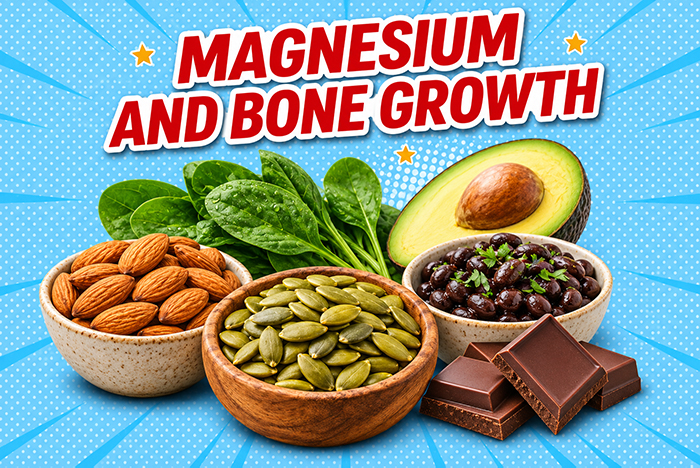
Magnesium gets far less attention than calcium and vitamin D, yet 50 to 60% of the magnesium in the body is stored in bone. So does it help children's bones grow, and could it help them grow taller? Here's what magnesium does in bone, what the research on children actually shows, how much kids and teens need at each age, the best food sources, and what to know before considering a supplement.
Quick Answer
In bone: about 50 to 60% of the body's magnesium is stored in the skeleton, and the mineral takes part in bone formation and affects the hormones that regulate bone.[1]
For height: we found no trials showing that extra magnesium makes healthy children taller. The only randomized trial in children in the National Osteoporosis Foundation's review, with 44 girls aged 8 to 14 and low intakes, measured bone mineral content rather than height, and its main finding was borderline.[2][3]
What to do: meet the daily requirement through food: 240 mg for ages 9 to 13, and 410 mg for boys or 360 mg for girls aged 14 to 18.[1] Talk to a doctor before giving supplements, which have upper limits for children.[1]
What Magnesium Does in Bone
Magnesium is a cofactor in more than 300 enzyme systems, and it contributes to the structural development of bone.[1] An adult body holds about 25 grams of magnesium, and 50 to 60% of it is in the bones.[1] Magnesium influences bone in four main ways:
Magnesium works as part of a team. The National Osteoporosis Foundation's systematic review of bone development in youth found the strongest evidence for calcium (grade A) and good evidence for vitamin D (grade B), while magnesium and other micronutrients were graded D, with only one randomized trial for magnesium.[3] To cover the other two members of the team, see the importance of calcium for bone growth, does vitamin D make you taller?, and our Calcium Intake Calculator for Kids & Teens and Vitamin D Intake Calculator.
Why the preteen and teen years matter. Bone mineral builds up fastest around puberty: for total-body bone mineral, the peak rate of gain comes at about 12.5 years in girls and 14.1 years in boys of European ancestry.[3] About 39% of total bone mineral is gained in the 4 years around that peak, and 95% of adult bone mass is in place 4 years after it.[3] Lifestyle choices, including nutrition and physical activity, influence 20 to 40% of adult peak bone mass, while genetics accounts for roughly 60 to 80% of the variation.[3][6] For more on this stage, see height growth during puberty.
What the Research Shows
The evidence runs from severe-deficiency experiments in animals to a single supplement trial in girls. Here's how the main pieces compare:
| Type of evidence | What it found | How much weight to give it |
|---|---|---|
| Animal studies with severe deficiency | In young mice on a very low-magnesium diet, the growth plate was 33% narrower with fewer cartilage cell columns.[5] In rats, severe deficiency impaired bone growth and weakened bone, along with low parathyroid hormone and active vitamin D.[4] | Shows magnesium matters when severely lacking. The rat model's degree of deficiency probably isn't common in people.[4] |
| Randomized trial in girls aged 8–14 | Girls whose diets gave under 220 mg a day took 300 mg of magnesium (as oxide) or a placebo for 12 months. The magnesium group gained more bone mineral at the hip (P = 0.05); the spine difference was not significant.[2] The trial included 44 girls.[3] | Encouraging but small: one trial, white girls with low intakes, and a borderline result at one site. Its main outcome was bone mineral, not height.[2][3] |
| U.S. national survey of 2,398 children aged 8–19 | After adjusting for body size, income, and other factors, magnesium intake was not significantly linked to femoral neck bone density in any age group overall. Links appeared only in some age-and-sex subgroups.[6] | Observational and mixed. A survey can't show that magnesium caused any difference.[6] |
| Expert review of youth bone health | Rated the evidence for micronutrients other than calcium and vitamin D, including magnesium, at grade D, based on one randomized trial for magnesium.[3] | Magnesium is considered important for bone, but the evidence for boosting intake is thin. |
| 69 trials of nutrition and height in children over 2 | Zinc, vitamin A, multiple-micronutrient formulas, and protein improved height gain, especially in populations with growth failure. Iron, calcium, iodine, and food-based programs did not. Magnesium was not among the nutrients analyzed.[7] | Shows which nutrients have height evidence. Magnesium on its own is not on that list. |
Summaries of the cited studies; "borderline" refers to a P value of about 0.05.[2][3][4][5][6][7]
Put together, the findings suggest that magnesium is needed for normal bone development and that low intake can hold back bone gain, but we found nothing showing that magnesium beyond a child's needs builds more bone or adds height.
Does Magnesium Make You Taller?
Growth faltering can come from a shortage of a single nutrient, several micronutrients, protein, energy, or a combination.[7] Of the single micronutrients covered in a review of 69 trials in children over 2, only zinc and vitamin A had a measurable effect on height, and for zinc the effect was larger in children who were already short for their age.[7] Magnesium wasn't among the nutrients covered, so claims that a magnesium supplement will add inches are not backed by trial evidence.
The practical takeaway is to make sure your child isn't short on magnesium, rather than trying to add more. For a fuller picture of everything that shapes growth, see the nutrition and height connection, factors that stunt growth in children, and height increase myths, debunked. For another mineral that does have height-related trial evidence, try our Zinc Intake Calculator.
How Much Magnesium Kids and Teens Need
The Food and Nutrition Board sets a Recommended Dietary Allowance (RDA) for magnesium for most ages, and an Adequate Intake for babies under 12 months.[1] It also sets an upper limit for magnesium from supplements and medicines, which does not count magnesium naturally found in food.[1]
| Age | Daily recommendation | Upper limit from supplements and medicines |
|---|---|---|
| 0–6 months | 30 mg* | None established |
| 7–12 months | 75 mg* | None established |
| 1–3 years | 80 mg | 65 mg |
| 4–8 years | 130 mg | 110 mg |
| 9–13 years | 240 mg | 350 mg |
| 14–18 years | 410 mg (boys) · 360 mg (girls) | 350 mg |
Source: NIH Office of Dietary Supplements, based on the Food and Nutrition Board's Dietary Reference Intakes.[1] *Adequate Intake. For young children the upper limit is lower than the daily recommendation because it excludes magnesium from food. Use our Magnesium Intake Calculator to check your child's target.
Many people fall short. In national survey data from 2013 to 2016, 48% of Americans of all ages took in less magnesium from food and drinks than the estimated average requirement, and adolescent boys and girls were among the groups most likely to have low intakes.[1] Even so, symptomatic deficiency from diet alone is uncommon in otherwise healthy people because the kidneys limit magnesium losses when intake is low.[1]
Best Food Sources of Magnesium
Green leafy vegetables, legumes, nuts, seeds, and whole grains are good sources, and foods with fiber tend to provide magnesium.[1] About 30 to 40% of the magnesium in food is absorbed.[1] The table shows what common foods provide and how that compares with the 240 mg recommended for ages 9 to 13.
| Food (serving) | Magnesium | Share of 240 mg (ages 9–13) |
|---|---|---|
| Pumpkin seeds, roasted, 1 oz | 156 mg | 65% |
| Chia seeds, 1 oz | 111 mg | 46% |
| Almonds, dry roasted, 1 oz | 80 mg | 33% |
| Spinach, boiled, ½ cup | 78 mg | 32% |
| Cashews, dry roasted, 1 oz | 74 mg | 31% |
| Peanuts, oil roasted, ¼ cup | 63 mg | 26% |
| Shredded wheat cereal, 2 large biscuits | 61 mg | 25% |
| Soymilk, plain or vanilla, 1 cup | 61 mg | 25% |
| Black beans, cooked, ½ cup | 60 mg | 25% |
| Edamame, shelled, cooked, ½ cup | 50 mg | 21% |
| Peanut butter, smooth, 2 tablespoons | 49 mg | 20% |
| Baked potato with skin, 3.5 oz | 43 mg | 18% |
| Brown rice, cooked, ½ cup | 42 mg | 18% |
| Yogurt, plain, low fat, 8 oz | 42 mg | 18% |
| Banana, 1 medium | 32 mg | 13% |
| Milk, 1 cup | 27 mg | 11% |
| Whole wheat bread, 1 slice | 23 mg | 10% |
| White rice, cooked, ½ cup | 10 mg | 4% |
Magnesium values from the USDA FoodData Central, as listed by the NIH Office of Dietary Supplements;[1] the share of 240 mg is our calculation. Food labels use a Daily Value of 420 mg for ages 4 and up,[1] so a food listing 10% of the Daily Value (about 42 mg) provides roughly 18% of a 10-year-old's needs.
Refining matters: brown rice has about four times the magnesium of white rice, because refining grains removes the nutrient-rich germ and bran.[1] Tap, mineral, and bottled water can also contribute, ranging from 1 mg to more than 120 mg per liter depending on the source.[1]
- Choose whole grains: swap white rice, bread, and pasta for brown rice and whole-wheat versions when your child will accept them.[1]
- Add legumes and greens: beans, edamame, and cooked spinach are some of the most useful everyday sources.[1]
- Mind choking risks for young children: nuts, seeds, and thick chunks of nut butter are choking hazards for young children; the American Academy of Pediatrics advises keeping high-risk foods from children until age 4 or older, depending on development, and spreading nut butter thinly.[9]
- Plant-based eaters: see height-boosting foods for vegetarians for more magnesium-rich options.
Magnesium Supplements: What to Know
Needs should be met mainly through food, and supplements may help in cases where food alone can't meet them.[1] If you're considering one for your child, these points apply:
- Respect the upper limits: 65 mg for ages 1 to 3, 110 mg for ages 4 to 8, and 350 mg for ages 9 and up, counting all supplements and medicines.[1]
- The trial dose isn't a home dose: the 300 mg a day used in the girls' study is above the limit for ages 4 to 8 and close to the 350 mg limit for older children.[1][2]
- Expect stomach side effects at high doses: diarrhea, nausea, and abdominal cramping are the common ones, and carbonate, chloride, gluconate, and oxide forms are most often reported to cause diarrhea.[1]
- Form affects absorption: in small studies, aspartate, citrate, lactate, and chloride forms were absorbed better than oxide and sulfate.[1]
- Count hidden sources and check interactions: some antacids and laxatives contain magnesium (milk of magnesia provides 500 mg per tablespoon).[1] Tetracycline and quinolone antibiotics should be taken at least 2 hours before or 4 to 6 hours after a magnesium supplement.[1]
- Know the serious risk: very large doses from laxatives and antacids (more than 5,000 mg a day) have caused magnesium toxicity, including a fatal case in a toddler, and the risk is higher with kidney problems.[1]
For a broader look at what supplements can and can't do, read our guide to the best height growth supplements.
When to Talk to a Doctor
Blood tests are an imperfect guide because most magnesium is inside cells or bone, so serum levels don't reflect total body stores well.[1] A doctor looks at diet, symptoms, health conditions, and medicines together. This article is for education and doesn't replace medical advice.
Track growth over time with our Growth Chart Tracker so you can show your pediatrician the full pattern.
FAQs
Does magnesium make you taller?
How does magnesium help bone growth?
How much magnesium does my child need?
What are the best food sources of magnesium for kids?
Should my child take a magnesium supplement?
Can you get too much magnesium from food?
References
- [1] NIH Office of Dietary Supplements. Magnesium: fact sheet for health professionals (updated January 6, 2026). ods.od.nih.gov
- [2] Carpenter TO, DeLucia MC, Zhang JH, Bejnerowicz G, Tartamella L, Dziura J, Petersen KF, Befroy D, Cohen D. A randomized controlled study of effects of dietary magnesium oxide supplementation on bone mineral content in healthy girls. Journal of Clinical Endocrinology & Metabolism. 2006;91(12):4866-4872. pubmed.ncbi.nlm.nih.gov/17018656
- [3] Weaver CM, Gordon CM, Janz KF, Kalkwarf HJ, Lappe JM, Lewis R, O'Karma M, Wallace TC, Zemel BS. The National Osteoporosis Foundation's position statement on peak bone mass development and lifestyle factors: a systematic review and implementation recommendations. Osteoporosis International. 2016;27(4):1281-1386. pubmed.ncbi.nlm.nih.gov/26856587
- [4] Rude RK, Singer FR, Gruber HE. Skeletal and hormonal effects of magnesium deficiency. Journal of the American College of Nutrition. 2009;28(2):131-141. pubmed.ncbi.nlm.nih.gov/19828898
- [5] Rude RK, Gruber HE, Wei LY, Frausto A, Mills BG. Magnesium deficiency: effect on bone and mineral metabolism in the mouse. Calcified Tissue International. 2003;72:32-41. link.springer.com
- [6] Gou GH, Tseng FJ, Wang SH, Chen PJ, Shyu JF, Pan RY. Nutritional factors associated with femoral neck bone mineral density in children and adolescents. BMC Musculoskeletal Disorders. 2019. doi:10.1186/s12891-019-2901-9. ncbi.nlm.nih.gov/pmc/articles/PMC6839089
- [7] Roberts JL, Stein AD. The impact of nutritional interventions beyond the first 2 years of life on linear growth: a systematic review and meta-analysis. Advances in Nutrition. 2017;8(2):323-336. pmc.ncbi.nlm.nih.gov/articles/PMC5347103
- [8] Harvard T.H. Chan School of Public Health. The Nutrition Source: Magnesium. nutritionsource.hsph.harvard.edu
- [9] American Academy of Pediatrics, HealthyChildren.org. Choking prevention for babies and children. healthychildren.org