Foods to Avoid for Optimal Height Growth

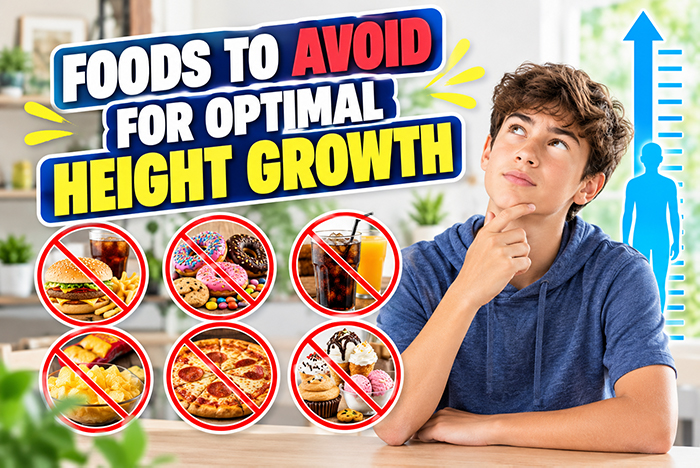
Most height advice focuses on what to eat more of. But what your child or teen eats less of matters just as much — some everyday foods and drinks don't just fail to help growth, they actively work against the conditions your body needs to reach its genetic height potential. Here's what the research actually shows about foods and habits that quietly get in the way of healthy growth, and what to do instead.
Quick Answer
No single food stunts growth on its own, but a diet consistently heavy in certain foods can quietly work against your genetic height potential. Sugar-sweetened drinks and highly processed snacks tend to crowd out the protein, calcium, and vitamin D growing bones actually need. High-sodium diets increase how much calcium the body loses through urine, which matters during the exact years bones are still accumulating mass. Excess caffeine can interfere with calcium absorption and cut into the deep sleep where growth hormone is released. Alcohol directly suppresses the growth hormone/IGF-1 axis. And severely restrictive dieting — even when well-intentioned — has been shown to measurably stunt growth in adolescents. None of these "cause" short stature by themselves, but consistently avoiding them removes real, documented obstacles to reaching a child's full height potential.
Why "What to Avoid" Matters Just as Much as "What to Eat"
Diet doesn't raise the genetic ceiling — but a poor one can stop a child from reaching it. Hover (or tap) each side for details.
Height is largely set by genetics, as we cover in our guide to the role of genetics in determining height. But that genetic potential still depends on a body that has what it needs — enough protein, calcium, vitamin D, and quality sleep — to actually build bone during the growth window. Foods that displace those nutrients, disrupt hormone signaling, or interfere with mineral absorption don't change a child's genes, but they can chip away at the conditions those genes need to express themselves fully. If you're focused on what actively supports that process, see our companion guide on foods to boost growth hormone — this article covers the other side of that same coin.
5 Foods and Habits to Limit for Healthy Growth
Easy Swaps: What to Reach for Instead
| Instead of | Try | Why It Helps |
|---|---|---|
| Soda or sweetened juice | Milk, fortified plant milk, or water | Adds calcium and vitamin D instead of empty sugar calories |
| Salty packaged snacks | Fruit, plain nuts, or yogurt | Lowers sodium load that increases calcium loss |
| Energy drinks or extra coffee | Herbal tea or water, especially after midday | Protects calcium absorption and evening sleep quality |
| Skipping meals to "cut calories" | Regular, balanced meals with adequate protein | Keeps total energy intake sufficient for normal growth |
| Frequent fast food or fried food | Home-prepared meals with lean protein and vegetables | Improves overall nutrient density without added effort |
"Forget the Sugar, Here Are Some Healthy Snack Swaps for Kids" — Registered Dietitian Dolores Woods, UT Health Houston School of Public Health, walks through practical swaps like the ones above. Watch on YouTube ↗
What This Means For You
The practical takeaway: no single food determines how tall a child ends up. But a diet consistently high in sugar-sweetened drinks, sodium, caffeine, and alcohol — or one that's severely calorie-restricted — creates real, documented obstacles to reaching genetic height potential. Limiting these, most of the time, is a simple and low-effort way to protect the growth process already underway.
FAQs
Can soda actually stunt your growth?
Is caffeine bad for a growing teenager's height?
Does alcohol affect height growth in teens?
Can dieting or skipping meals stunt a teenager's growth?
Is it too late to fix a diet that's been high in these foods?
References
- [1] Kaplowitz PB. Link between body fat and the timing of puberty. Pediatrics. 2008;121(Suppl 3):S208-S217. PMID: 18245513.
- [2] Quader ZS, Zhao L, Gillespie C, et al. Sodium Intake Among US School-Aged Children — 2009–2010. MMWR Morbidity and Mortality Weekly Report. 2014;63(46):1050-1057.
- [3] Matkovic V, Ilich JZ, Andon MB, et al. Urinary calcium, sodium, and bone mass of young females. American Journal of Clinical Nutrition. 1995;62(2):417-425. PMID: 7625350.
- [4] Heaney RP. Effects of caffeine on bone and the calcium economy. Food and Chemical Toxicology. 2002;40(9):1263-1270. PMID: 12204390.
- [5] Rachdaoui N, Sarkar DK. Effects of alcohol on the endocrine system. Endocrinology and Metabolism Clinics of North America. 2013;42(3):593-615. PMID: 24011889.
- [6] Modan-Moses D, Yaroslavsky A, Novikov I, et al. Stunting of growth as a major feature of anorexia nervosa in male adolescents. Pediatrics. 2003;111(2):270-276. PMID: 12563050.