Average Hand Size for Men and Women (Chart by Height)

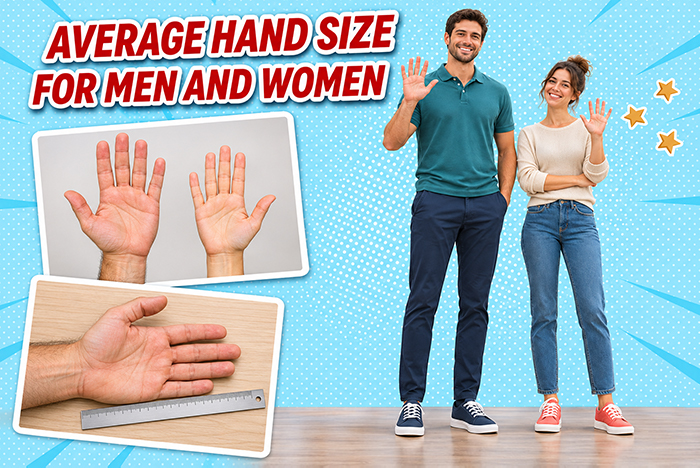
Most people have never measured their hands, and "average" gets quoted with little context. To get real numbers, we analyzed measured hand length, width, and circumference for more than 6,000 U.S. Army men and women. Here's the average hand size for men and women, the normal range, how hand size changes with height, which glove size fits most people, how to measure your own hand, and when a change in hand size is worth a doctor visit.
Quick Answer
Men: the average hand is about 7.6 inches (193 mm) long, 3.5 inches (88 mm) wide, and 8.4 inches (212 mm) around.[1]
Women: the average hand is about 7.1 inches (181 mm) long, 3.1 inches (78 mm) wide, and 7.3 inches (187 mm) around.[1]
The gap: men's hands are about 7% longer and 13% wider. Lengths overlap a lot, since about 11% of women have a hand longer than the typical man's, but widths barely do, since fewer than 1% of women have a hand broader than the typical man's.[1]
Average Hand Size for Men and Women
The numbers come from ANSUR II, the U.S. Army's 2012 anthropometric survey, which directly measured the right hand of 4,082 men and 1,986 women aged 17 to 58.[1][2] Hand length runs from a bony landmark at the wrist to the tip of the middle finger, and hand breadth is measured across the knuckles, from the index finger side to the little finger side, with the palm flat on a table.[3] The sample represents the U.S. Army in 2010 to 2012 rather than the whole U.S. population,[1] but its average heights (5'9.1" for men and 5'4.1" for women) are close to the national averages of 5'8.9" and 5'3.5".[4]
| Measurement | Men — Average | Men — Middle 90% | Women — Average | Women — Middle 90% | Men larger by |
|---|---|---|---|---|---|
| Hand length | 7.6 in (193 mm) | 7.0–8.3 in | 7.1 in (181 mm) | 6.5–7.8 in | +6.7% |
| Hand breadth (width) | 3.5 in (88 mm) | 3.2–3.8 in | 3.1 in (78 mm) | 2.8–3.3 in | +12.9% |
| Hand circumference | 8.4 in (212 mm) | 7.7–9.1 in | 7.3 in (187 mm) | 6.8–8.0 in | +13.8% |
Our analysis of ANSUR II measured data.[1] "Middle 90%" runs from the 5th to the 95th percentile, so 9 in 10 adults fall inside it. "Men larger by" compares the two averages.
The overlap is the main takeaway. About 90% of men have a hand length between 7.0 and 8.3 inches, and about 90% of women between 6.5 and 7.8 inches, so a 7.5-inch hand is completely ordinary for either sex. Hand width separates the sexes more clearly than length does.[1]
Hand Size by Height
Taller people tend to have bigger hands, and the pattern is steady: each extra inch of height goes with about a tenth of an inch of hand length for both sexes.[1] Find your height below to see the typical hand length and the range that covers the middle 80% of people at that height.
Men
| Height | Median hand length | Middle 80% | Median breadth | Men measured |
|---|---|---|---|---|
| 5'2" (157 cm) | 6.9 in (174 mm) | 6.5–7.1 in | 3.2 in | 23 |
| 5'3" (160 cm) | 6.9 in (176 mm) | 6.7–7.3 in | 3.2 in | 39 |
| 5'4" (163 cm) | 7.1 in (181 mm) | 6.9–7.5 in | 3.3 in | 84 |
| 5'5" (165 cm) | 7.2 in (183 mm) | 6.9–7.6 in | 3.3 in | 196 |
| 5'6" (168 cm) | 7.3 in (185 mm) | 7.0–7.6 in | 3.4 in | 348 |
| 5'7" (170 cm) | 7.4 in (188 mm) | 7.0–7.8 in | 3.4 in | 411 |
| 5'8" (173 cm) | 7.5 in (190 mm) | 7.2–7.9 in | 3.4 in | 569 |
| 5'9" (175 cm) | 7.6 in (193 mm) | 7.2–8.0 in | 3.5 in | 608 |
| 5'10" (178 cm) | 7.7 in (196 mm) | 7.4–8.1 in | 3.5 in | 572 |
| 5'11" (180 cm) | 7.8 in (197 mm) | 7.4–8.1 in | 3.5 in | 468 |
| 6'0" (183 cm) | 7.9 in (200 mm) | 7.5–8.3 in | 3.6 in | 326 |
| 6'1" (185 cm) | 8.0 in (202 mm) | 7.6–8.3 in | 3.5 in | 212 |
| 6'2" (188 cm) | 8.1 in (205 mm) | 7.7–8.6 in | 3.6 in | 108 |
| 6'3" (191 cm) | 8.2 in (209 mm) | 7.7–8.5 in | 3.6 in | 56 |
| 6'4" (193 cm) | 8.3 in (212 mm) | 8.0–8.7 in | 3.6 in | 35 |
Women
| Height | Median hand length | Middle 80% | Median breadth | Women measured |
|---|---|---|---|---|
| 4'11" (150 cm) | 6.7 in (170 mm) | 6.3–7.0 in | 2.9 in | 43 |
| 5'0" (152 cm) | 6.7 in (171 mm) | 6.4–7.0 in | 3.0 in | 85 |
| 5'1" (155 cm) | 6.9 in (174 mm) | 6.5–7.2 in | 3.0 in | 143 |
| 5'2" (157 cm) | 6.9 in (176 mm) | 6.5–7.3 in | 3.0 in | 222 |
| 5'3" (160 cm) | 7.0 in (178 mm) | 6.6–7.4 in | 3.0 in | 304 |
| 5'4" (163 cm) | 7.1 in (180 mm) | 6.8–7.5 in | 3.1 in | 329 |
| 5'5" (165 cm) | 7.2 in (183 mm) | 6.8–7.7 in | 3.1 in | 270 |
| 5'6" (168 cm) | 7.3 in (185 mm) | 7.0–7.7 in | 3.1 in | 243 |
| 5'7" (170 cm) | 7.4 in (189 mm) | 7.0–8.0 in | 3.2 in | 134 |
| 5'8" (173 cm) | 7.4 in (188 mm) | 7.1–7.9 in | 3.1 in | 91 |
| 5'9" (175 cm) | 7.6 in (193 mm) | 7.2–8.0 in | 3.2 in | 61 |
| 5'10" (178 cm) | 7.8 in (197 mm) | 7.5–8.2 in | 3.3 in | 30 |
Our analysis of ANSUR II measured stature and hand dimensions, grouped to the nearest inch of height.[1] "Middle 80%" runs from the 10th to the 90th percentile. Heights with fewer than 20 men or 30 women are not shown.
At the same height, men's and women's hands are similar in length but not in width. A 5'8" man has a median hand length of 7.5 inches and a 5'8" woman 7.4 inches, but his median breadth is 3.4 inches against her 3.1.[1] That also explains the length gap in the averages: hand length is nearly the same share of height in both sexes (11.0% and 11.1%), so men's longer hands largely reflect men being taller.[1] For more on average stature, see the average height of Americans.
Does Hand Size Predict Height?
Only roughly. Hand length averaged 11.0% of height in men and 11.1% in women, with most people between about 10.3% and 11.9%,[1] which gives a handy rule of thumb: height ≈ 9 × hand length. For a 7.6-inch hand, that predicts about 5'8".
Use the rule for a ballpark only. Our Shoe Size to Height Estimator and Wingspan to Height Ratio Calculator give other body-proportion clues, and our shoe data is in average shoe size by height for men and women. Body proportions run in families, so the role of genetics in determining height is a good next read.
Does Hand Size Change With Age?
In adults, hand length is close to constant across the decades this survey covers.
| Age group | Men — Average hand length | Men measured | Women — Average hand length | Women measured |
|---|---|---|---|---|
| 17–24 | 192 mm (7.6 in) | 1,358 | 180 mm (7.1 in) | 767 |
| 25–29 | 193 mm (7.6 in) | 931 | 181 mm (7.1 in) | 468 |
| 30–34 | 193 mm (7.6 in) | 610 | 181 mm (7.1 in) | 264 |
| 35–39 | 195 mm (7.7 in) | 449 | 182 mm (7.2 in) | 181 |
| 40–58 | 195 mm (7.7 in) | 734 | 182 mm (7.2 in) | 306 |
Our analysis of ANSUR II.[1] The survey compares different people at one point in time, so it can't show how an individual's hands change over time.
Averages differ by only about 2 mm between the youngest and oldest groups, far less than the 12 mm gap in average hand length between men and women.[1] The survey doesn't include children, so it can't show how hands grow up to adult size.
Glove Sizes: What Fits Most People
Protective and work gloves follow the EN ISO 21420 standard (formerly EN 420), which defines each glove size by a hand circumference and a hand length.[5] The UK Health and Safety Executive translates these into familiar labels, from XS (EU 6) to XXL (EU 11), and lists the width and length ranges for each.[6] Applying those ranges to our measured hands shows where most people fall.
By hand width (circumference)
| Glove size | Hand circumference | % of men | % of women |
|---|---|---|---|
| XS (EU 6) | Under 178 mm (under 7 in) | 0% | 16% |
| S (EU 7) | 178–203 mm (7–8 in) | 17% | 79% |
| M (EU 8) | 203–229 mm (8–9 in) | 77% | 4% |
| L (EU 9) | 229–254 mm (9–10 in) | 6% | 0% |
| XL (EU 10) | 254–279 mm (10–11 in) | 0% | 0% |
| XXL (EU 11) | 279 mm and over (11+ in) | 0% | 0% |
By hand length
| Glove size | Hand length | % of men | % of women |
|---|---|---|---|
| XS (EU 6) | Under 171 mm (under 6.7 in) | 1% | 14% |
| S (EU 7) | 171–182 mm (6.7–7.2 in) | 11% | 40% |
| M (EU 8) | 182–192 mm (7.2–7.6 in) | 32% | 31% |
| L (EU 9) | 192–204 mm (7.6–8.0 in) | 41% | 12% |
| XL (EU 10) | 204–215 mm (8.0–8.5 in) | 13% | 2% |
| XXL (EU 11) | 215 mm and over (8.5+ in) | 2% | 0% |
Our analysis of ANSUR II hand measurements, grouped with the width and length ranges listed by the UK Health and Safety Executive.[1][6] The HSE gives width bands; for length we treated each listed length as the start of its band, the same pattern. Percentages may not add to 100 because of rounding.
Width and length often point to different sizes. By width, 77% of men fall in medium and 79% of women in small, but by length, 42% of men land in large and women are split mainly between small (40%) and medium (31%).[1] That's one reason glove charts ask for both measurements. Treat these percentages as approximate: glove charts measure length from the wrist crease and width just below the knuckles,[6] while ANSUR starts hand length at a bony wrist landmark[3] and may take circumference at a slightly different spot, and brands also size their gloves differently. Compare your own numbers with the specific brand's chart.
How to Measure Your Hand
- Use your dominant hand: glove guides ask you to measure the hand you use most.[6]
- Measure length: measure from the bottom edge of the palm, at the wrist, to the tip of the middle finger.[6]
- Measure width: wrap a tape around your hand just below the knuckles, excluding the thumb, and make a fist.[6]
- Read in inches or millimeters: convert with our Length Converter Calculator, since glove charts use both.
- Match to the brand's chart: if your length and width fall in different sizes, check what that brand recommends before ordering.
Want to compare your hand with your height? Measure your height the same day using our guide on how to measure height correctly.
When to Talk to a Doctor
Having larger or smaller hands than average isn't a medical issue on its own. What matters is a change. This article is for education and doesn't replace medical advice.
The first two signs can point to acromegaly, a condition in which the body makes too much growth hormone. It is rare, affecting an estimated 3 to 14 of every 100,000 people, and because symptoms come on slowly, problems can develop before it is diagnosed.[7]
FAQs
What is the average hand size for men?
What is the average hand size for women?
Is hand size related to height?
What glove size fits most men and women?
How do you measure your hand size?
Does hand size change with age?
References
- [1] U.S. Army 2012 Anthropometric Survey (ANSUR II) working databases: "ANSUR II MALE Public.csv" (n = 4,082) and "ANSUR II FEMALE Public.csv" (n = 1,986). Analysis of measured hand length, hand breadth, hand circumference, and stature by HeightGrowthBlog. Database overview: ph.health.mil
- [2] Gordon CC, et al. 2012 anthropometric survey of U.S. Army personnel: methods and summary statistics. Technical Report NATICK/TR-15/007. U.S. Army Natick Soldier Research, Development and Engineering Center; 2014. apps.dtic.mil
- [3] Definitions of ANSUR-compatible hand dimensions (hand length and hand breadth), Table 8, PMC4698842. pmc.ncbi.nlm.nih.gov/articles/PMC4698842
- [4] Fryar CD, Gu Q, Afful J, Carroll MD, Ogden CL. Anthropometric reference data for children and adults: United States, August 2021–August 2023. Vital and Health Statistics, Series 3. 2025;(50). National Center for Health Statistics. cdc.gov
- [5] Wenaas. EN ISO 21420:2020 (formerly EN 420): general requirements and test methods for protective gloves, including the hand-size table. wenaas.com
- [6] UK Health and Safety Executive. Choosing the right gloves to protect skin: a guide for employers (glove sizes and how to measure your hand). hse.gov.uk
- [7] National Institute of Diabetes and Digestive and Kidney Diseases. Acromegaly. niddk.nih.gov