Is Your Wingspan Longer Than Your Height? What’s Normal by Age

Stretch your arms out wide and measure from fingertip to fingertip, and for most adults the number comes out a little longer than their height. But "a little" varies with age, sex, and ancestry, and in children the answer is often the opposite. Here's how wingspan compares with height for typical adults and children, a quick chart for your height, what a long wingspan means in sports, and when it's worth a closer look.
Quick Answer
For most adults, yes, slightly. In more than 6,000 U.S. Army recruits, the average wingspan-to-height ratio was about 1.03 for men and 1.02 for women,[3][4] meaning wingspan was about 2 to 3% longer than height.
Young children are the exception: at age 2, arm span is on average about 1.2 cm shorter than height in boys and 4.8 cm shorter in girls. By 17, it's about 1.5 cm longer in both.[2]
It varies a lot: the ratio is higher in men than women and differs between populations,[1] and a wingspan noticeably shorter or longer than your height is usually normal variation.
Wingspan vs Height in Adults
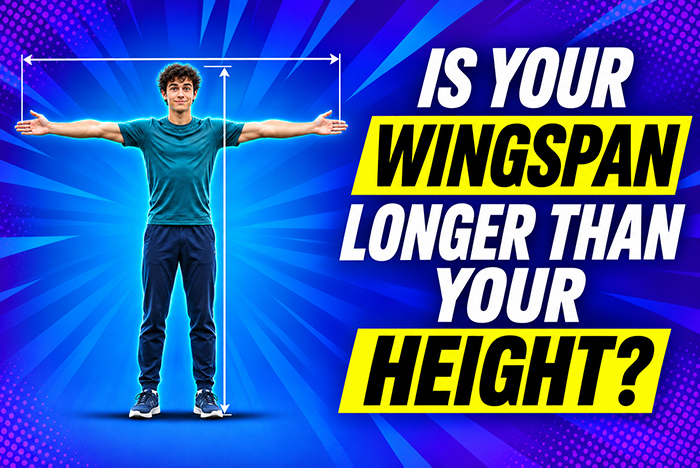
Wingspan (also called arm span) is the distance from one middle fingertip to the other with the arms stretched out sideways at shoulder height. The old rule of thumb says it equals your height. Large studies show it's usually a bit longer, and by how much depends on who you are.
| Group | Average wingspan ÷ height | What it means |
|---|---|---|
| U.S. Army recruits, men | 1.03 (±0.03) | Wingspan about 3% longer than height |
| U.S. Army recruits, women | 1.02 (±0.03) | Wingspan about 2% longer than height |
| European adults, men | about 1.025 | Slightly longer than height |
| European adults, women | about 1.020 | Slightly longer than height |
| Asian, Iranian, and Ghanaian adults | higher than Europeans; up to about 1.07 in middle-aged Ghanaian men | Relatively longer arms |
U.S. Army data from Monson et al. (2018), as reported by Kirk et al.;[3][4] European and international values from Quanjer et al. (2014), as summarized by Gerver et al.;[1][2] that study's "Europe" group also included a few non-European centres with similar body proportions. "±0.03" is one standard deviation.
For the average U.S. man, who stands about 5'8.9" (175.1 cm), a ratio of 1.03 works out to a wingspan roughly 2 inches (5 cm) longer than his height. For the average U.S. woman, at about 5'3.5" (161.2 cm), a ratio of 1.02 adds about 1.3 inches (3 cm).[3][6] With a standard deviation of 0.03, plenty of healthy adults have a wingspan equal to or even shorter than their height. For more on average stature, see the average height of Americans.
Typical Wingspan for Your Height
Find your height to see roughly what wingspan the average woman (ratio 1.02) and man (ratio 1.03) would have, and the wingspan at which the ratio reaches 1.05.
| Height | Typical wingspan, women (×1.02) | Typical wingspan, men (×1.03) | Ratio 1.05 |
|---|---|---|---|
| 5'0" (152 cm) | 5'1.2" | 5'1.8" | 5'3.0" (160 cm) |
| 5'2" (157 cm) | 5'3.2" | 5'3.9" | 5'5.1" (165 cm) |
| 5'4" (163 cm) | 5'5.3" | 5'5.9" | 5'7.2" (171 cm) |
| 5'6" (168 cm) | 5'7.3" | 5'8.0" | 5'9.3" (176 cm) |
| 5'8" (173 cm) | 5'9.4" | 5'10.0" | 5'11.4" (181 cm) |
| 5'10" (178 cm) | 5'11.4" | 6'0.1" | 6'1.5" (187 cm) |
| 6'0" (183 cm) | 6'1.4" | 6'2.2" | 6'3.6" (192 cm) |
| 6'2" (188 cm) | 6'3.5" | 6'4.2" | 6'5.7" (197 cm) |
| 6'4" (193 cm) | 6'5.5" | 6'6.3" | 6'7.8" (203 cm) |
| 6'6" (198 cm) | 6'7.6" | 6'8.3" | 6'9.9" (208 cm) |
Simple multiplications of height by the average ratios in U.S. Army recruits[3][4] and by 1.05, the adult cutoff used in Marfan syndrome criteria.[5] Your own ratio may differ by several percent and still be completely normal. For an exact figure, use our Wingspan to Height Ratio Calculator.
Wingspan vs Height in Children
In young children, the arms are relatively short, so wingspan is usually less than height. Reference data from about 2,600 Dutch children measured from birth to 17 show the gap closing steadily through childhood.[2]
| Age | Boys — Wingspan minus height | Girls — Wingspan minus height |
|---|---|---|
| 2 years | −1.2 cm (−0.5 in) | −4.8 cm (−1.9 in) |
| 17 years | +1.5 cm (+0.6 in) | +1.6 cm (+0.6 in) |
Mean values from the Maastricht study of 2,595 Caucasian children, as reanalyzed by Gerver et al. (2020).[2]
So if your 6-year-old's arm span comes up short of their height, that's expected. The arms keep gaining on height through adolescence, and in men the ratio continues to rise into the mid-20s.[1] To see how your child's height compares with others their age, try our Growth Percentile Calculator.
How the Ratio Changes With Age
In a study of nearly 14,000 people aged 5 to 99, the wingspan-to-height ratio didn't stay fixed through life.[1]
Because the arms don't shrink with age, comparing your wingspan with your height later in life can hint at how much height you've lost. Learn more in why do we get shorter as we age? and with our Adult Height Loss Calculator.
Wingspan in Sports
In basketball and combat sports, a long reach is linked to success. In a study of about 3,000 NBA prospects, 1,300 mixed martial arts (MMA) fighters, and 6,000 U.S. Army recruits, NBA players had wider arm spans relative to their height than either fighters or recruits.[3]
- NBA: prospects averaged a ratio of about 1.06, compared with 1.03 for male Army recruits.[4] Players with a relatively longer wingspan were more likely to be drafted earlier.[3]
- MMA: fighters averaged about 1.02, but those with relatively longer arms tended to have better win-loss records.[3][4]
- Still normal: even stars with exceptional reach fell within the expected range of normal human variation.[7]
- Not a requirement: two-time NBA MVP Stephen Curry has a relative arm span below average for athletes.[7]
Like height, arm length stops increasing once the growth plates close. If your teen plays basketball, see does playing basketball make you taller?
How to Measure Your Wingspan
- Stand against a wall: back flat against the wall, feet together, facing forward.
- Raise your arms to shoulder height: stretch them straight out to the sides, parallel to the floor, palms facing forward.
- Reach, don't strain: extend fully through the fingertips without shrugging the shoulders or bending the elbows.
- Mark both middle fingertips: have a helper mark the wall at each fingertip, then measure the distance between the marks.
- Measure height the same day: without shoes, using the method in our guide on how to measure height correctly, then divide wingspan by height.
When to Talk to a Doctor
A long wingspan on its own is almost never a medical issue. In Marfan syndrome, a genetic connective tissue disorder, an adult arm span-to-height ratio above 1.05 counts toward the diagnosis only when it occurs together with a reduced upper-to-lower body segment ratio and no significant scoliosis, and even then it adds just 1 point to a multi-feature score.[5] Ethnic differences in typical arm span also need to be considered when applying this cutoff.[5]
FAQs
Is it normal for your wingspan to be longer than your height?
Is it bad if my wingspan is shorter than my height?
What is a good wingspan-to-height ratio?
What is the ape index?
Can you estimate height from wingspan?
Does a long wingspan mean Marfan syndrome?
References
- [1] Quanjer PH, Capderou A, Mazicioglu MM, Aggarwal AN, Banik SD, Popovic S, Tayie FAK, Golshan M, Ip MSM, Zelter M. All-age relationship between arm span and height in different ethnic groups. European Respiratory Journal. 2014;44(4):905-912. pubmed.ncbi.nlm.nih.gov/25063245
- [2] Gerver WJM, Gkourogianni A, Dauber A, Nilsson O, Wit JM. Arm span and its relation to height in a 2- to 17-year-old reference population and heterozygous carriers of ACAN variants. Hormone Research in Paediatrics. 2020;93(3):164-172. scholarlypublications.universiteitleiden.nl
- [3] Monson TA, Brasil MF, Hlusko LJ. Allometric variation in modern humans and the relationship between body proportions and elite athletic success. Journal of Anthropology of Sport and Physical Education. 2018;2(3):3-8. doi.org/10.26773/jaspe.180701
- [4] Kirk C, et al. Five-year analysis of age, stature, and armspan in professional mixed martial arts bouts. Research Quarterly for Exercise and Sport. 2023. doi.org/10.1080/02701367.2023.2252473
- [5] The Marfan Foundation. Calculation of systemic score (revised Ghent nosology; Loeys BL, et al. J Med Genet. 2010;47(7):476-485). marfan.org
- [6] Fryar CD, Gu Q, Afful J, Carroll MD, Ogden CL. Anthropometric reference data for children and adults: United States, August 2021–August 2023. Vital and Health Statistics, Series 3. 2025;(50). National Center for Health Statistics. cdc.gov
- [7] UC Berkeley News. Study shows wingspan has a correlation to athletic prowess in the NBA, MMA. July 17, 2018. news.berkeley.edu