Average Head Circumference by Age (0–3 Years): Boys & Girls Chart

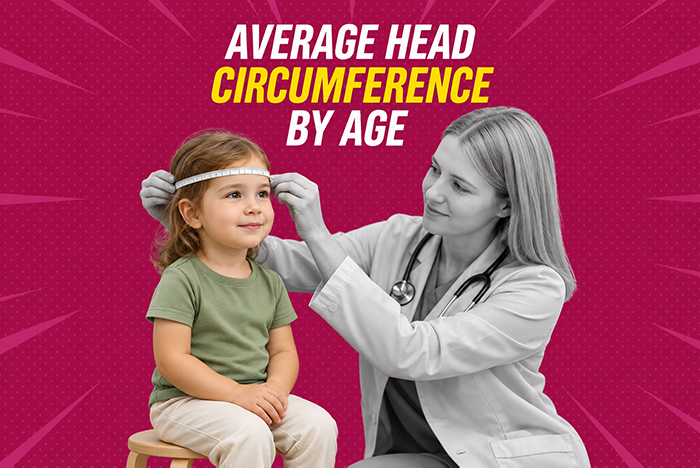
At well-baby checkups, your pediatrician wraps a tape around your baby's head, and for good reason: head size is one of the simplest ways to track how the brain is growing. Here's the average head circumference for boys and girls from birth to 3 years, the normal range at each age, how fast a baby's head grows, how to measure it at home, and which changes are worth raising with your doctor.
Quick Answer
At birth: the median head circumference is about 34.5 cm (13.6 in) for boys and 33.9 cm (13.3 in) for girls.[1][2]
At 1 year: about 46.1 cm (18.1 in) for boys and 44.9 cm (17.7 in) for girls. At 3 years: about 49.5 cm (19.5 in) for boys and 48.5 cm (19.1 in) for girls.[1][2]
Growth is front-loaded: a baby's head grows about 11 to 12 cm (around 4.5 in) in the first year, and about half of that happens in the first 3 months.[1][2] What matters most is steady growth along your child's own curve.[7]
Head Circumference Chart by Age (0–3 Years)
This chart uses the World Health Organization (WHO) Child Growth Standards, which describe how healthy children grow under good conditions. The CDC and the American Academy of Pediatrics recommend the WHO charts for all U.S. children from birth to 2 years, whether they are breastfed or formula-fed.[3] From age 2, the CDC recommends switching to its own growth charts;[3] for consistency, this table continues with WHO values up to age 3.
| Age | Boys — Median | Boys — Normal range | Girls — Median | Girls — Normal range |
|---|---|---|---|---|
| Birth | 34.5 cm (13.6 in) | 32.1–36.9 cm | 33.9 cm (13.3 in) | 31.7–36.1 cm |
| 1 month | 37.3 cm (14.7 in) | 35.1–39.5 cm | 36.5 cm (14.4 in) | 34.3–38.8 cm |
| 2 months | 39.1 cm (15.4 in) | 36.9–41.3 cm | 38.3 cm (15.1 in) | 36.0–40.5 cm |
| 3 months | 40.5 cm (16.0 in) | 38.3–42.7 cm | 39.5 cm (15.6 in) | 37.2–41.9 cm |
| 4 months | 41.6 cm (16.4 in) | 39.4–43.9 cm | 40.6 cm (16.0 in) | 38.2–43.0 cm |
| 5 months | 42.6 cm (16.8 in) | 40.3–44.8 cm | 41.5 cm (16.3 in) | 39.0–43.9 cm |
| 6 months | 43.3 cm (17.1 in) | 41.0–45.6 cm | 42.2 cm (16.6 in) | 39.7–44.6 cm |
| 9 months | 45.0 cm (17.7 in) | 42.6–47.4 cm | 43.8 cm (17.3 in) | 41.3–46.3 cm |
| 12 months | 46.1 cm (18.1 in) | 43.6–48.5 cm | 44.9 cm (17.7 in) | 42.3–47.5 cm |
| 15 months | 46.8 cm (18.4 in) | 44.3–49.3 cm | 45.7 cm (18.0 in) | 43.1–48.2 cm |
| 18 months | 47.4 cm (18.7 in) | 44.9–49.9 cm | 46.2 cm (18.2 in) | 43.6–48.8 cm |
| 21 months | 47.8 cm (18.8 in) | 45.3–50.4 cm | 46.7 cm (18.4 in) | 44.1–49.4 cm |
| 2 years | 48.3 cm (19.0 in) | 45.7–50.8 cm | 47.2 cm (18.6 in) | 44.6–49.8 cm |
| 2½ years | 48.9 cm (19.3 in) | 46.3–51.6 cm | 47.9 cm (18.9 in) | 45.3–50.6 cm |
| 3 years | 49.5 cm (19.5 in) | 46.8–52.1 cm | 48.5 cm (19.1 in) | 45.9–51.2 cm |
Source: WHO Child Growth Standards, head circumference-for-age, birth to 5 years. Median = 50th percentile; normal range = 3rd to 97th percentile.[1][2] Ages are completed months. For your own child's exact percentile, use our Head Circumference Percentile Calculator.
Boys' heads are slightly larger than girls' at every age, by about 0.6 cm at birth and about 1 cm by age 3.[1][2] The normal range is wide, roughly 4.5 to 5.5 cm at most ages, so two perfectly healthy babies of the same age and sex can have noticeably different head sizes. If your baby was born early, doctors usually plot head size by corrected age until age 2.[9] For length and weight at the same ages, see average height and weight for babies and toddlers.
How Fast a Baby's Head Grows
Head growth is fastest right after birth and slows steadily over the first three years. In the WHO standards, about half of the first year's head growth happens in the first 3 months.[1][2]
| Age period | Boys — Median gain | Girls — Median gain |
|---|---|---|
| Birth → 3 months | +6.1 cm (2.4 in) | +5.7 cm (2.2 in) |
| 3 → 6 months | +2.8 cm (1.1 in) | +2.7 cm (1.0 in) |
| 6 → 12 months | +2.7 cm (1.1 in) | +2.7 cm (1.1 in) |
| 1 → 2 years | +2.2 cm (0.9 in) | +2.3 cm (0.9 in) |
| 2 → 3 years | +1.2 cm (0.5 in) | +1.3 cm (0.5 in) |
Calculated from the differences between WHO median values at each age.[1][2] Individual babies grow in a less even pattern, so compare growth over several visits rather than one interval.
Why Head Size Matters
Head size is an indicator of the size of the brain underneath.[6] The brain grows fastest before birth and in the first two years of life, which is why measuring head size during this period is so useful for spotting growth that is too slow or too fast.[9] At each checkup, your doctor compares the new measurement with your child's earlier measurements and with normal ranges for their sex and age.[7]
Head size also tends to run in families. A family tendency toward a large head, called benign familial macrocephaly, is one recognized and harmless reason for a bigger-than-average head.[8] To keep all of your child's measurements in one place, try our Growth Chart Tracker.
How to Measure Head Circumference
Your pediatrician's measurement is the one that counts, but you can take a reasonable reading at home with the same method clinicians use.[6]
- Use a tape that doesn't stretch: such as a paper or plastic measuring tape.[6]
- Find the widest part of the head: place the tape just above the eyebrows and ears in front and over the most prominent part of the back of the head.[6][7]
- Pull it snug, not tight: the tape should lie flat against the head, and hair clips or braids should be removed first.
- Measure three times: record each reading to the nearest 0.1 cm and use the largest.[6]
- Don't worry about a misshapen newborn head: pressure during delivery can temporarily change the head's shape, which is why the first measurement is usually taken within 24 hours of birth or a little later if needed.[5]
Convert between centimeters and inches with our Length Converter Calculator. For tips on measuring length and height, see how to measure height correctly.
How to Read Head Circumference Percentiles
A percentile shows how your child's head size compares with other children of the same age and sex. The 50th percentile is the middle: half of children are larger and half are smaller. A baby at the 20th percentile isn't "behind," and one at the 85th isn't "ahead." Both are within the normal range.
| Percentile range | What it usually means |
|---|---|
| Below the 3rd | Smaller than expected; your doctor will look at the trend and other measurements[9] |
| 3rd to 97th | Normal range; steady growth along a similar percentile line is the goal |
| Above the 97th | Larger than expected; your doctor will look at the growth rate and family head sizes[4][8] |
For screening with the WHO charts, the CDC recommends cutoffs of about 2 standard deviations from the median (the 2.3rd and 97.7th percentiles),[4] which are very close to the 3rd and 97th percentiles shown in this article.
Doctors also compare head size with your child's length and weight.[10] A baby who is small overall will often have a smaller head too, which is different from a head that is small for an otherwise average-sized body. Our Growth Percentile Calculator and Weight-for-Length/Height Calculator help you see the whole picture.
When to Talk to a Doctor
FAQs
What is the average head circumference of a newborn?
What is a normal head circumference for a 1-year-old?
How much does a baby's head grow in the first year?
Why do doctors measure head circumference?
Is a big head on a baby something to worry about?
Do boys have bigger heads than girls?
References
- [1] World Health Organization. WHO Child Growth Standards: head circumference-for-age, boys, birth to 5 years (percentiles). who.int
- [2] World Health Organization. WHO Child Growth Standards: head circumference-for-age, girls, birth to 5 years (percentiles). who.int
- [3] Centers for Disease Control and Prevention. Summary: using WHO Child Growth Standards. cdc.gov
- [4] Grummer-Strawn LM, Reinold C, Krebs NF; Centers for Disease Control and Prevention. Use of World Health Organization and CDC growth charts for children aged 0–59 months in the United States. MMWR Recommendations and Reports. 2010;59(RR-9):1-15. core.ac.uk
- [5] Centers for Disease Control and Prevention. About microcephaly. cdc.gov
- [6] Centers for Disease Control and Prevention. Birth defects surveillance quick reference handbook: microcephaly (measurement of head size). archive.cdc.gov
- [7] MedlinePlus Medical Encyclopedia. Head circumference. medlineplus.gov
- [8] MedlinePlus Medical Encyclopedia. Increased head circumference. medlineplus.gov
- [9] Child and Adolescent Health Service, Western Australia. Head circumference assessment (clinical nursing procedure). cahs.health.wa.gov.au
- [10] Pregnancy, Birth and Baby (Australian Government). Microcephaly. pregnancybirthbaby.org.au