Does Swimming Make You Taller?

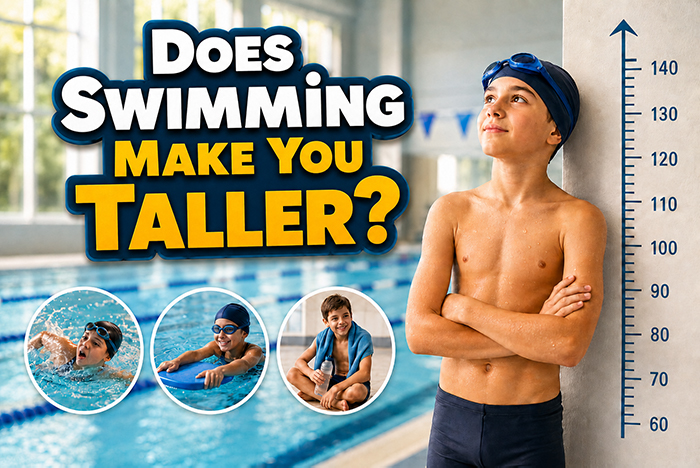
Swimming shows up on almost every "best sports for height" list parents find online — often alongside the claim that the stretching motion of strokes like freestyle and backstroke elongates the spine and helps kids grow taller. It's a compelling idea, and swimming genuinely is one of the best all-around activities for a growing child. But when you look at what the actual research says about swimming, bone growth, and height, the picture is more nuanced than the myth suggests. Here's what the evidence actually shows.
Key Takeaways
- No sport, including swimming, adds height beyond a child's genetic potential — height is determined mostly by genetics, with nutrition, sleep, and overall health filling in the rest.
- Because swimming is non-weight-bearing, research consistently shows it stimulates bone density less than impact sports like running, basketball, or gymnastics.
- Swimming still supports healthy growth indirectly: it builds cardiovascular fitness, muscle tone, and posture, and can improve sleep quality — all of which matter for a child reaching their full height potential.
- The "spine stretches and adds height" claim is based on a real but temporary phenomenon — daily spinal compression and decompression — that happens to everyone regardless of whether they swim.
- For the biology behind height potential itself, see our guide to The Role of Genetics in Determining Height, and for a broader look at exercise, see Exercise and Its Effect on Height Growth.
What Actually Determines a Child's Height
Before looking at swimming specifically, it helps to remember the bigger picture: twin studies estimate that genetics accounts for roughly 80% of the variation in adult height between individuals. Nutrition, sleep, and overall health fill in the rest — largely by determining how close a child gets to their own genetic ceiling, not by raising that ceiling. No single sport, food, or supplement changes this math. So the real question isn't "does swimming make you taller," but "does swimming help a child reach the height they were already going to reach" — and on that question, the evidence is more interesting.
What the Evidence Says About Swimming and Growth
▶ Watch: 2 Not-So-Healthy Aspects of Swimming
Watch on YouTube ↗The pattern across all of this research: swimming is a genuinely excellent sport for a child's overall health, but the specific claim that it "stretches" a child taller doesn't hold up — if anything, weight-bearing land sports have somewhat stronger evidence behind them for bone stimulation.
The "Spinal Decompression" Myth, Explained
A common version of this myth goes: swimming stretches and decompresses the spine, so consistent practice adds permanent height. It's true that the spine compresses slightly under gravity during the day and decompresses overnight — this is why almost everyone measures about 1-2 cm taller first thing in the morning than at night. But this daily cycle happens to everyone, swimmers and non-swimmers alike, and it fully resets each day rather than accumulating into permanent height gain. Swimming may feel like it "lengthens" the body because it's performed horizontally with reduced gravitational load, but there's no evidence this translates into any lasting change in bone length.
So Should Kids Swim for Height?
Swimming remains one of the best sports a child can do — it's low-impact, joint-friendly, builds cardiovascular and muscular fitness, and is genuinely enjoyable for most kids, which matters for building a lifelong exercise habit. It just isn't a specific "height booster" beyond what any consistent, healthy physical activity provides. Parents looking to combine swimming with something that has slightly stronger direct evidence for bone stimulation might pair it with a weight-bearing activity like running, jump rope, or basketball a couple of times a week, alongside consistent sleep and good nutrition — the factors that matter most for reaching genetic height potential.
Continue Reading
❓ Frequently Asked Questions
Does swimming make you taller?
No. Swimming doesn't add height beyond a child's genetic potential. It's an excellent, low-impact sport for overall health, but it doesn't stimulate bone growth more than other physical activity, and current evidence suggests it may stimulate bone density somewhat less than weight-bearing sports.
Why do people believe swimming stretches your spine and adds height?
It likely comes from the real but temporary daily cycle of spinal compression and decompression that everyone experiences, combined with the fact that swimming is performed horizontally and feels like a full-body stretch. Neither of these mean the effect is permanent or specific to swimmers.
Is swimming bad for bone growth since it's non-weight-bearing?
No, swimming doesn't harm bone growth or impair a child's linear growth. It simply doesn't stimulate bone density as strongly as impact sports do, since bones respond to mechanical loading and water reduces that loading.
What sport is best for a child's height?
No sport increases height beyond genetic potential, but sports with more impact and weight-bearing movement, like basketball, running, or jump rope, have somewhat stronger evidence for stimulating bone density during the growing years. A mix of activities, including swimming, is a reasonable approach.
Should my child still swim if it doesn't add height?
Yes. Swimming offers excellent cardiovascular, muscular, and mental health benefits, and it's gentle on developing joints, which makes it a great long-term activity regardless of its effect on height specifically.
📚 References
- Gomez-Bruton A, Montero-Marín J, González-Agüero A, García-Campayo J, Moreno LA, Casajús JA, Vicente-Rodríguez G. The Effect of Swimming During Childhood and Adolescence on Bone Mineral Density: A Systematic Review and Meta-Analysis. Sports Medicine. 2016;46(3):365–379. pubmed.ncbi.nlm.nih.gov/26607734
- Alves JGB, Alves GV. Effects of Physical Activity on Children's Growth. Jornal de Pediatria. 2019;95(Suppl 1):S72–S78. doi.org/10.1016/j.jped.2018.11.003
- Yang Y, Sun Z, Zhong X, et al. Association Between Outdoor Physical Activity and Height Growth Velocity in Chinese Children Aged 9–15: A Secondary Analysis of a National Population-Based Cohort. Healthcare. 2026;14(5):628. pubmed.ncbi.nlm.nih.gov/41827582
- Reilly T, Tyrrell A, Troup JD. Circadian Variation in Human Stature. Chronobiology International. 1984;1(2):121–126. pubmed.ncbi.nlm.nih.gov/6600017