Does Cycling Stunt Growth? What the Evidence Says

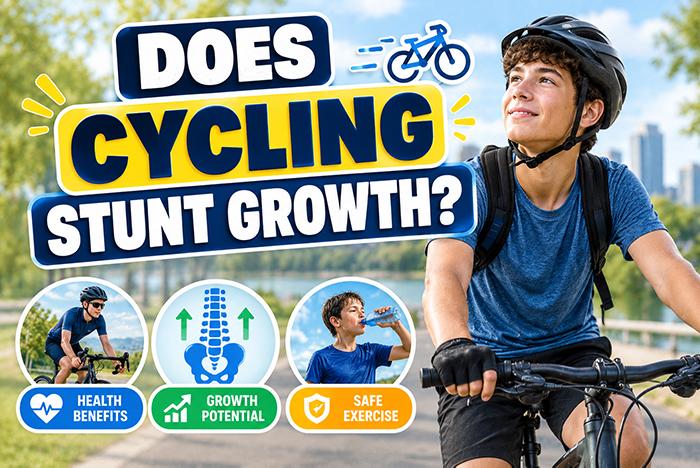
Long rides, hard hill climbs, and pedaling against resistance for hours: it's easy to see why some parents worry that cycling could hold a growing child back. The good news is that the worry doesn't match the evidence. Here's what research says about exercise and height, the few real issues that heavy cycling can cause in young riders, and how to keep a growing cyclist healthy.
Quick Answer
No. We found no research showing that cycling stunts growth. A widely cited review of the evidence concluded that regular physical activity, sport participation, and training for sport have no effect on attained height, the timing of the adolescent growth spurt, or the rate of growth.[1] That review looked at team sports, swimming, track, rowing, and gymnastics rather than cycling specifically, but nothing we reviewed points to the bike itself as a cause of shorter height. What can interfere with growth in young athletes is not eating enough to fuel heavy training, and what cycling doesn't do much for is bone strength, which is a separate issue from height.[2][5]
Where the Worry Comes From
The idea usually runs like this: cycling puts repeated pressure on the legs, the growth plates near the knees are soft cartilage, so pushing on them over and over must squash or shut them down early. It sounds logical, but it gets the biology backwards. Growth plates handle the ordinary, repeated loads of walking, running, jumping, and pedaling every day. Research on physical activity and the growth plates links real harm mainly to acute injuries such as fractures and to extreme repetitive overload, not to normal exercise.[4]
This is the same pattern as the old claim that lifting weights stunts growth, which evidence also doesn't support. For what genuinely holds growth back in children, see our guide to factors that stunt growth in children.
▶ Watch: Cycling Can Make You Taller: Fact or Myth?
Watch on YouTube ↗What Heavy Cycling Can Actually Affect
Casual riding to school or around the neighborhood is not a concern. The points below matter mostly for young riders who train a lot, race, or ride long distances.
Worth separating: low bone loading and under-fueling are risks of a lot of training with too little food or variety, not of cycling itself. A child who rides for fun, eats well, and plays other sports is not at meaningful risk.
Cycling vs. Other Sports
No common sport has been shown to stunt growth, so the difference between activities is mainly how much they load the bones.
| Activity | Effect on height | Bone loading | Main thing to watch |
|---|---|---|---|
| Cycling | No evidence of harm | Low (non-weight-bearing) | Fueling for heavy training, crashes, adding impact sports[2][5] |
| Running, jumping, and team sports | No effect on attained height[1] | Higher (weight-bearing) | Overuse knee and heel pain in growing kids[7] |
| Swimming | No effect on attained height[1] | Low (non-weight-bearing) | Pair with some weight-bearing activity |
Weight-bearing activity is linked to better bone health in children and adolescents, particularly at the loaded sites.[7]
If a young rider also wants to support bone health, adding running, jumping, or ball sports is an easy fix. Our guides to the benefits of playing sports for height development and the best height growth exercises for teenagers cover good options.
How to Keep a Growing Cyclist Healthy
- Fuel the ride: a young rider training hard needs enough total food, with protein, carbohydrates, and calcium. Our Daily Calorie Needs Calculator and the nutrition and height connection are good starting points.
- Mix in weight-bearing sports: running, jumping, or ball games a few times a week give the bones the loading cycling doesn't.
- Check the bike fit: a seat and handlebars sized for the child, and a seat height that lets the knee stay slightly bent at the bottom of the stroke, reduce knee strain as kids grow.
- Build volume gradually: a sudden jump in distance or intensity is a common trigger for overuse pain in growing athletes.
- Always wear a helmet: crashes are the most direct way a cyclist's growth plates are put at risk.
- Track growth over time: plotting height on a chart, for example with our Growth Chart Tracker, makes a change in growth pattern easy to spot.
When to Talk to a Doctor
A pediatrician or sports medicine doctor can review the growth curve, the child's diet, and training load. Our Height-for-Age Z-Score Calculator is an educational tool, not a replacement for that evaluation.
FAQs
Does cycling stunt growth?
Can cycling make you taller?
Can a bike seat that is too high or too low affect a child's growth?
Is competitive cycling safe for teenagers?
Is cycling bad for teenagers' bones?
References
- [1] Malina RM. Physical activity and training: effects on stature and the adolescent growth spurt. Medicine & Science in Sports & Exercise. 1994;26(6):759-766. pubmed.ncbi.nlm.nih.gov/8052116
- [2] Mountjoy M, et al. IOC consensus statement on relative energy deficiency in sport (RED-S): 2018 update. British Journal of Sports Medicine. 2018;52(11):687-697. doi:10.1136/bjsports-2018-099193
- [3] Mountjoy M, et al. 2023 International Olympic Committee's (IOC) consensus statement on Relative Energy Deficiency in Sport (REDs). British Journal of Sports Medicine. 2023.
- [4] Mirtz TA, et al. The effects of physical activity on the epiphyseal growth plates: a review of the literature on normal physiology and clinical implications. Journal of Clinical Medicine Research. jocmr.org
- [5] Olmedillas H, et al. Cycling and bone health: a systematic review. BMC Medicine. 2012;10:168. link.springer.com
- [6] Olmedillas H, González-Agüero A, Moreno LA, Casajús JA, Vicente-Rodríguez G. Bone related health status in adolescent cyclists. PLoS ONE. 2011;6(9):e24841. doi:10.1371/journal.pone.0024841
- [7] Brown KA, et al. Participation in sports in relation to adolescent growth and development. Translational Pediatrics. 2017. tp.amegroups.org