Does Gymnastics Stunt Growth? Why Gymnasts Are So Short

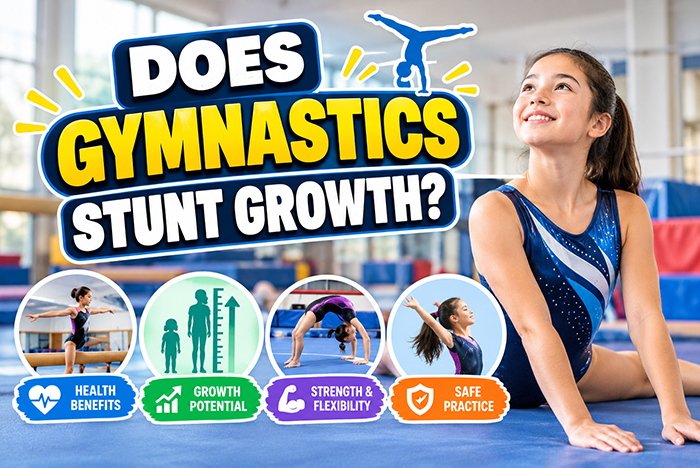
Elite gymnasts are famously small, and many parents have heard that starting gymnastics young can keep a child from reaching her full height. It's a reasonable worry, because the pattern is real: gymnasts do tend to be shorter than other athletes. The question is whether the sport causes it. Here's what the research says about gymnastics and growth, why gymnasts end up so short, what is still uncertain, and what young gymnasts genuinely need to stay healthy.
Quick Answer
Not as far as the evidence shows, but the sport's short-stature reputation has a real explanation. A 2013 review by a team of growth and sport-medicine researchers concluded that the adult height of female and male artistic gymnasts is not compromised by intensive training, that training does not appear to slow growth of the legs or trunk, and that it does not appear to delay puberty. Gymnasts as a group look like short, later-maturing kids who aren't athletes, which points to inborn factors and to who gets selected into the sport rather than to the sport itself.[1] The question isn't entirely closed, since a few studies reported slower growth in young elite gymnasts, but those studies couldn't separate training from everything else in the gymnastics environment.[2] What does deserve attention is eating enough for the training load and watching for overuse injuries.
Why Gymnasts Tend to Be Short
The short stature and later maturation seen in female artistic gymnasts have often been blamed on intensive training from a young age.[1] But there is a simpler explanation that fits the data better: selection. Gymnastics rewards a small, light, strong body, so coaches and talent programs tend to pick children who are already small for their age, and children who mature late stay small, and stay competitive, for longer. As puberty brings growth and a change in body proportions, taller and earlier-maturing girls are more likely to move on to other sports. The athletes left at the elite level are a filtered group, not a typical sample of kids who started gymnastics.
This is the same trap as in basketball, where the court is full of tall players because height is a competitive advantage rather than because the sport makes people taller. See our article on whether playing basketball makes you taller for the same logic from the other direction.
What the Research Found
The most thorough review to date, published in Sports Medicine, reached three main conclusions after weighing the available studies of artistic gymnasts of both sexes.[1]
| What parents often hear | What the evidence says |
|---|---|
| "Gymnastics makes girls short." | Adult height is not compromised by intensive training. Shorter stature is mainly linked to inborn factors and selection into the sport.[1] |
| "Gymnasts have shorter legs." | Training does not appear to slow growth of leg or trunk length.[1] |
| "Gymnastics delays puberty." | Training does not appear to slow the timing or pace of puberty; later maturation resembles that of late-maturing non-athletes.[1] Low energy intake is a separate issue (see below). |
Findings are for artistic gymnasts and rest on data available through the review's cutoff; they describe groups, not guarantees for any individual child.
What Is Still Uncertain
The picture isn't completely settled. An earlier review of the literature on whether gymnastics training inhibits growth in females found three cohort studies that reported reduced growth in young gymnasts, but training could not be separated from other factors in the gymnastics environment.[2] Some reports also describe slower growth during the competitive years followed by catch-up growth once training is reduced or athletes retire, although the evidence on how complete that catch-up is has been described as conflicting.[2] The 2013 review likewise noted that, given limits in the data, inadequate specification of training, and the failure to consider other influences on growth, it has not been possible to establish a cause-and-effect relationship between training and growth in young gymnasts either way, and that the evidence for hormonal changes in gymnasts is inadequate to draw conclusions.[1]
What that means in practice: the best available evidence says gymnastics itself does not shorten adult height, but it can't rule out that extreme training combined with too little food, too little sleep, or other stresses might slow a particular child's growth. That is a reason to look after the whole child, not a reason to avoid the sport.
What Young Gymnasts Actually Need to Watch
How to Keep a Young Gymnast Healthy
- Fuel the training: regular meals and snacks with enough protein, carbohydrate, calcium, and vitamin D. See the nutrition and height connection and the Daily Calorie Needs Calculator.
- Protect rest days and sleep: recovery is part of training, especially during growth spurts.
- Track growth over time: plotting height on a chart, for example with our Growth Chart Tracker, shows whether growth is following her usual curve.
- Compare against family height: the Mid-Parental Height Calculator shows where a child is likely to land based on her parents' heights, which is a fairer yardstick than other gymnasts.
- Take pain seriously: new or lasting wrist, back, or heel pain is a reason to rest and see a doctor.
- Choose supportive coaching: a program that avoids weigh-ins and weight talk and builds in rest is a safer environment for a growing athlete.
▶ Watch: Kids Exercises To Grow Taller: Home Activities
Watch on YouTube ↗When to Talk to a Doctor
A pediatrician or sports medicine doctor can review the growth curve, diet, and training load. Our Height-for-Age Z-Score Calculator is an educational tool, not a replacement for that evaluation.
FAQs
Does gymnastics stunt growth?
Why are gymnasts so short?
Can gymnastics delay puberty?
Is it safe for a child to start gymnastics young?
Can gymnastics make you taller?
References
- [1] Malina RM, Baxter-Jones ADG, Armstrong N, Beunen GP, Caine D, Daly RM, Lewis RD, Rogol AD, Russell K. Role of intensive training in the growth and maturation of artistic gymnasts. Sports Medicine. 2013;43(9):783-802. doi:10.1007/s40279-013-0058-5. pubmed.ncbi.nlm.nih.gov/23743792
- [2] Caine D, Lewis R, O'Connor P, Howe W, Bass S. Does gymnastics training inhibit growth of females? Clinical Journal of Sport Medicine. 2001;11(4):260-270. doi:10.1097/00042752-200110000-00009
- [3] Mountjoy M, et al. IOC consensus statement on relative energy deficiency in sport (RED-S): 2018 update. British Journal of Sports Medicine. 2018;52(11):687-697. doi:10.1136/bjsports-2018-099193
- [4] Mirtz TA, et al. The effects of physical activity on the epiphyseal growth plates: a review of the literature on normal physiology and clinical implications. Journal of Clinical Medicine Research. jocmr.org