The Impact of Exercise on Height Growth

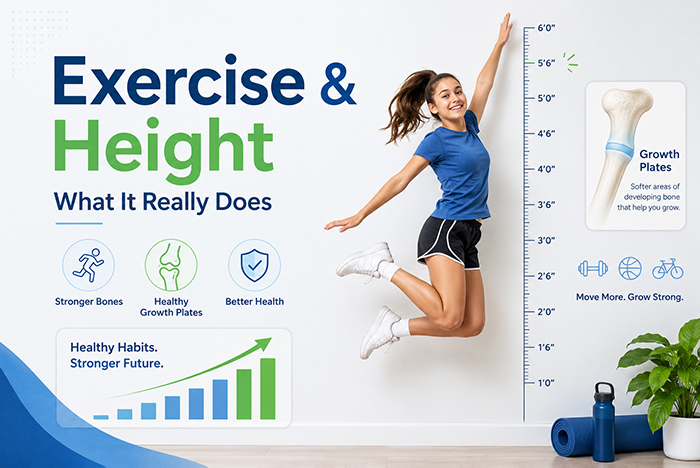
"Playing basketball won't make you taller" is true, but it is also easy to overcorrect into "exercise has nothing to do with height," which is not quite right either. Physical activity genuinely touches the growth process through two real, measurable pathways — it just cannot rewrite the genetic ceiling those pathways operate within. This guide separates what exercise actually does for a growing body from what is simply correlation, using the same growth-plate biology covered in our piece on common height myths.
Key Takeaways
Exercise affects growth through two distinct pathways: a short-lived spike in growth hormone during and after a workout, and a longer-term boost to bone mineral accrual from weight-bearing activity — neither one raises a child's genetic height ceiling.
Elite athlete research is the clearest natural experiment available: decades of data on gymnasts, who train intensively from a young age, show no measurable reduction in adult height once genetics and self-selection are accounted for.
Exercise can blunt growth, but only through a specific failure mode — training hard without eating enough to match it, a state called relative energy deficiency, which is a nutrition problem wearing an exercise costume.
Weight-bearing exercise (running, jumping, resistance training) has a real, evidence-backed benefit during childhood and adolescence: building peak bone mass, which pays off decades later in reduced fracture risk.
For the hormonal side of the growth window and how sleep fits in, see our companion pieces on Human Growth Hormone (HGH) and Height and Sleep and Height: What the Research Actually Shows.
What Exercise Can Actually Do for a Growing Body
None of what follows changes the core fact covered in our myths guide: bones lengthen at the growth plate, and once that cartilage fuses at the end of puberty, no amount of activity adds skeletal height. Within that window, though, exercise is not inert. It interacts with two real biological systems involved in growth — it just does so by supporting the process already underway, not by expanding its ceiling.
A single bout of sufficiently intense exercise triggers a short-term spike in growth hormone release, on top of the hormone's normal overnight rhythm. This is well documented and consistent across studies — but it is a transient hormonal event, not a growth signal that accumulates into extra height over time the way people sometimes assume.
Weight-bearing exercise — running, jumping, resistance training — places mechanical load on bone that stimulates it to lay down more mineral density, particularly during childhood and the early pubertal years. This is a genuinely useful, well-supported effect. It builds a stronger, denser skeleton; it does not lengthen the bones that make up standing height.
The Exercise-Induced Growth Hormone Response
The link between exercise and growth hormone is real, well-studied, and often misunderstood as more significant for height than it actually is.
▶ Watch: Exercise To Boost HGH (Human Growth Hormone) — Dr. Berg
Watch on YouTube ↗This is the same hormone discussed in our HGH and Height guide, where the dominant, most consequential pulse of the day happens during deep sleep, not during a workout.
What Sport-Specific Research Actually Shows
If exercise genuinely added height beyond genetics, decades of youth sport data would show it clearly. Instead, the research on specific sports keeps landing on the same conclusion from our myths guide: correlation, not causation, explains most of what people notice about athletes' height.
When Exercise Can Actually Blunt Growth
There is one well-documented way physical activity genuinely can slow a young athlete's growth — but it is really a nutrition failure that shows up alongside exercise, not a direct effect of the exercise itself. It is called relative energy deficiency in sport, or RED-S: a sustained mismatch between the calories an athlete eats and the calories intensive training demands.
The fix is not less exercise — it is adequate fueling for the exercise being done. This is a solvable problem with proper nutrition and, when needed, medical and coaching support, not a reason to avoid youth sports.
What This Means for a Growing Child
The practical picture is straightforward once the two real mechanisms are separated from the myths. Regular physical activity, especially weight-bearing movement, is worth encouraging for its own sake — it builds peak bone mass that pays dividends decades later, supports healthy body composition, and (through the acute GH pulse) is part of a normally functioning growth system. What it will not do is push a child past the ceiling set by genetics, which twin studies estimate accounts for roughly 80% of the variation in adult height between people. The one real caution is fueling: an active child, especially one training seriously in a sport, needs enough food to match their output. Restricting calories while training hard is the one scenario where "exercise affected my height" has genuine evidence behind it — and even then, the fix is the plate, not the training log.
❓ Frequently Asked Questions
Does exercise increase growth hormone in a way that makes kids taller?
Exercise does trigger a short-term spike in growth hormone, especially at higher intensities, but this is a transient hormonal event rather than something that accumulates into extra adult height. The dominant, most consequential growth hormone pulse of the day happens during deep sleep, not during a workout.
Can intensive training in a sport like gymnastics stunt a child's growth?
The most thorough review of the evidence, commissioned by gymnastics' own international governing body, found that intensive training does not compromise adult height or alter the timing of the pubertal growth spurt. Gymnasts tend to be shorter because shorter, later-maturing children are more likely to take up and succeed in the sport.
Is there any real way exercise can hurt a child's growth?
Yes, but through nutrition, not the exercise itself. Training hard without eating enough to match it, a state called relative energy deficiency in sport, can genuinely compromise growth and bone health. The solution is adequate fueling, not less activity.
What is the actual benefit of exercise for a growing child's bones, if not height?
Weight-bearing exercise measurably increases bone mineral accrual during childhood and early puberty, building toward a higher peak bone mass. This is a genuine, evidence-backed benefit that reduces fracture risk decades later, even though it does not add to standing height.
Should I encourage my child to play sports if it won't make them taller?
Yes. Regular physical activity supports bone health, healthy body composition, cardiovascular fitness, and general wellbeing regardless of its effect on height. The absence of a height benefit is not a reason to skip exercise — it is simply not the mechanism to rely on if height is the specific goal.
📚 References
- Godfrey RJ, Madgwick Z, Whyte GP. The Exercise-Induced Growth Hormone Response in Athletes. Sports Medicine. 2003;33(8):599–613. pubmed.ncbi.nlm.nih.gov/12797841
- Hind K, Burrows M. Weight-Bearing Exercise and Bone Mineral Accrual in Children and Adolescents: A Review of Controlled Trials. Bone. 2007;40(1):14–27. pubmed.ncbi.nlm.nih.gov/16956802
- Malina RM, Baxter-Jones ADG, Armstrong N, et al. Role of Intensive Training in the Growth and Maturation of Artistic Gymnasts. Sports Medicine. 2013;43(9):783–802. pubmed.ncbi.nlm.nih.gov/23743792
- Mountjoy M, Ackerman KE, Bailey DM, et al. 2023 International Olympic Committee's (IOC) Consensus Statement on Relative Energy Deficiency in Sport (REDs). British Journal of Sports Medicine. 2023;57(17):1073–1097. pubmed.ncbi.nlm.nih.gov/37752011
- Silventoinen K, Sammalisto S, Perola M, et al. Heritability of Adult Body Height: A Comparative Study of Twin Cohorts in Eight Countries. Twin Research. 2003;6(5):399–408. pubmed.ncbi.nlm.nih.gov/14624724