Does Soccer Make You Taller? Why Pro Players Are Tall

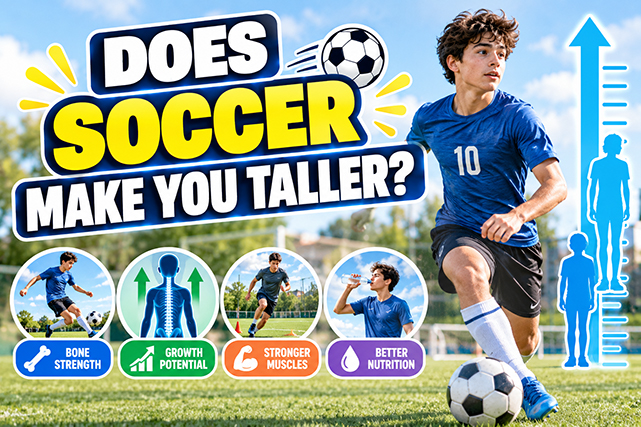
Soccer is the world's most popular sport, and walk through almost any youth academy or professional squad and many of the players are tall. It's natural to wonder whether all that running, jumping, and heading adds inches. The real story is more interesting, and it matters for any parent whose child is thinking about playing at a high level. Here's what soccer does and doesn't do for height, why so many top young players are tall, and what it means for late bloomers.
Quick Answer
No. Playing soccer does not make you taller, and it does not make you shorter either. A widely cited review found that regular physical activity and sport training have no effect on attained height, the timing of the adolescent growth spurt, or the rate of growth.[1] Soccer is a healthy, weight-bearing sport that supports bone health,[3] but height is set by genetics, hormones, nutrition, and sleep. The reason so many top young players are tall is selection: academies tend to choose, and keep, boys who are biologically ahead of their peers, and those boys are temporarily bigger.[2][5]
Why So Many Top Young Players Are Tall
Children of the same age can differ by years in how far along puberty they are. A boy who matures early is, for a while, taller, heavier, stronger, and faster than classmates of the same age, even if he ends up an average-sized adult. Youth coaches who select the best players at 12, 13, and 14 often end up picking the boys who are simply further along.
This is the same trap as in basketball: the sport is full of tall people because of who gets selected, not because the sport makes anyone taller. See does playing basketball make you taller? for the same logic.
What Soccer Actually Does for a Growing Body
None of this makes soccer less valuable for kids. Running, jumping, sprinting, and changing direction are weight-bearing and high-impact, which is the kind of activity linked to stronger bones during the growing years.[3] It also builds fitness, coordination, and teamwork.
| Question | What the evidence says |
|---|---|
| Does soccer add height? | No evidence it does. Height is set by genetics, hormones, nutrition, and sleep.[1] |
| Does soccer stunt growth? | No. Regular physical activity and sport training have no effect on attained height or the timing of the growth spurt.[1] |
| Is soccer good for bones? | Yes. It is weight-bearing and high-impact, which supports bone health in children and adolescents.[3] |
| Why are elite players so tall? | Selection of boys who are bigger or more mature for their age, plus positions that favor height.[2][5] |
Most of the selection research is on boys in academy programs, and findings describe groups rather than any individual child.
▶ Watch: How to Grow Taller As a Footballer
Watch on YouTube ↗What This Means for Late Bloomers
The practical lesson is for parents of players who are small for their age. Being cut from a team at 13 doesn't predict adult height, and it doesn't mean a child lacks talent. Researchers note that selection that favors early maturers can mean coaches overlook late-maturing players who may have higher long-term potential.[2] A boy who is behind his peers on the field may simply be waiting for his growth spurt, which typically peaks later than many parents expect.
Worth knowing: if your child's size is the thing holding him back in a program, find out where he is in puberty before drawing conclusions. Our Peak Height Velocity Calculator and Tanner Stage Finder can help show whether the fastest growth is still ahead, and height growth during puberty explains the timeline.
One Real Caution: Growth Plate Pain
The genuine soccer-related issue for growing children is overuse pain at the growth plates. Sever's disease, an inflammation of the growth plate in the heel, is a common cause of heel pain in active children and adolescents, especially in sports with a lot of running and jumping.[4] Knee pain at the front of the shin is another common complaint in growing athletes. These conditions are usually managed with rest from the aggravating activity and gradual return, and they don't stop a child from growing, but pain that persists should be examined by a doctor rather than played through.
How to Support a Young Player
- Fuel the training: regular meals with enough protein, carbohydrate, calcium, and vitamin D. See the nutrition and height connection and the Calcium Intake Calculator for Kids & Teens.
- Protect sleep: most growth hormone is released in deep sleep. See how sleep affects height growth.
- Build in rest days and variety: playing other sports and having days off helps avoid overuse pain in growing kids.
- Track growth over time: plotting height on a chart, for example with our Growth Chart Tracker, shows whether growth is following the child's usual curve.
- Judge by development, not just size: if your child is small for his age, compare him with his own growth curve and his parents' heights using the Mid-Parental Height Calculator, not with early-maturing teammates.
When to Talk to a Doctor
A pediatrician or sports medicine doctor can review the growth curve, check how far along puberty is, and assess any pain. Our Height-for-Age Z-Score Calculator is an educational tool, not a replacement for that evaluation.
FAQs
Does soccer make you taller?
Does soccer stunt growth?
Why are professional soccer players so tall?
Can a short or late-maturing kid succeed in soccer?
Is soccer good for kids' bones?
References
- [1] Malina RM. Physical activity and training: effects on stature and the adolescent growth spurt. Medicine & Science in Sports & Exercise. 1994;26(6):759-766. pubmed.ncbi.nlm.nih.gov/8052116
- [2] The selection advantages associated with advanced biological maturation vary according to playing position in national-level youth soccer. ncbi.nlm.nih.gov/pmc/articles/PMC10286617
- [3] Brown KA, et al. Participation in sports in relation to adolescent growth and development. Translational Pediatrics. 2017. tp.amegroups.org
- [4] American Academy of Orthopaedic Surgeons (OrthoInfo). Sever's disease (calcaneal apophysitis). orthoinfo.aaos.org
- [5] The relative age effect and the relationship between biological maturity and athletic performance in Austrian elite youth soccer players. Frontiers in Sports and Active Living. 2025. frontiersin.org