Do Calf Raises Make You Taller?

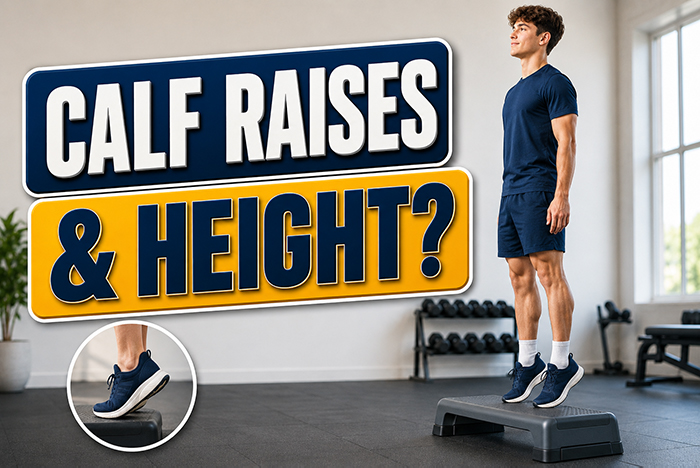
A claim circulating in online fitness and "height growth" communities says weighted calf raises can lengthen your shinbone (tibia) and add real height. It's a specific, testable claim — so let's actually look at what calf raises do to your body, and what the science on bone growth really supports.
Do Calf Raises Make You Taller?
No — there's no credible evidence that calf raises, weighted or otherwise, increase height or lengthen the tibia. Calf raises are a genuinely effective exercise for building calf muscle and ankle stability, but that's a different body system than the one responsible for how tall you grow.
▶ Watch: Do Calf Raises Make You Taller? - How To Grow Taller
Watch on YouTube ↗What Calf Raises Actually Do
A calf raise — rising onto the balls of your feet, with or without added weight — targets the gastrocnemius and soleus, the two muscles that make up your calf. Done consistently, calf raises can:
- Build calf muscle size and strength through standard muscular hypertrophy.
- Improve ankle stability, which can help reduce injury risk in sports and daily movement.
- Support athletic performance in activities involving running, jumping, and quick direction changes.
- Improve circulation in the lower legs.
All genuinely useful — none of it involves the part of the leg bone where height growth actually happens.
What Actually Makes Bones Longer
Bones like the tibia get longer at growth plates (epiphyseal plates) — regions of cartilage near each end of the bone where new bone tissue is produced during childhood and adolescence. This process is primarily controlled by growth hormone, IGF-1, and sex hormones, and it continues only until the growth plates fuse into solid bone, typically by the late teens.
Mechanical loading does matter for bone health — weight-bearing activity is well established to support bone density and, in animal studies, can influence growth plate activity under specific controlled loading conditions. But "loading matters for bone health in general" is a very different claim from "this specific exercise lengthens this specific bone" — and that's the gap the calf raise claim doesn't close.
Why the "Weighted Calf Raise" Claim Doesn't Hold Up
Animal studies have shown that controlled, intermittent mechanical loading applied directly to a bone's growth plate can influence longitudinal growth. This is real, published science.
Those studies used precisely controlled compressive forces applied directly across a specific growth plate in a lab setting — nothing like the load pattern a voluntary calf raise produces through the ankle and calf muscle-tendon unit. No human study has demonstrated that calf raises specifically lengthen the tibia.
In short: the underlying biology (mechanical loading can influence growth plates in controlled conditions) is real and interesting — but it's been stretched into a specific exercise claim that current evidence simply doesn't support. This is a common pattern in "heightmaxxing" content: a real, technical-sounding scientific fact gets attached to an unrelated home exercise as if it proves the exercise works.
A Real Risk Worth Knowing About
Heavy, high-volume weighted calf raises in a still-growing teenager aren't just "probably not helpful" for height — they carry a real, if modest, injury risk. The Achilles tendon attaches at the heel, right at the growth plate responsible for Sever's disease (calcaneal apophysitis), a common overuse injury in active adolescents. Repetitive, heavy loading through the calf-Achilles-heel chain is a plausible way to aggravate that growth plate, not stimulate the unrelated tibial growth plate higher up the leg.
What Actually Supports Height Growth
If the goal is genuinely supporting height growth during the years it's still possible, the better-supported levers are the same ones covered throughout this site: a mix of weight-bearing and impact activity (running, jumping, sports), adequate protein and micronutrient intake, and consistent sleep, since growth hormone release peaks during deep sleep. None of these "unlock" extra height beyond genetics, but they help someone reach the height their genes already have planned.
For a full breakdown of exercises with genuine evidence behind them, see our guide to the best height growth exercises for teenagers.
Calf raises are a solid exercise for calf strength, ankle stability, and athletic performance — reasons enough to keep doing them. But the specific claim that weighted calf raises lengthen your tibia and add height doesn't hold up against what's actually known about how bones grow. If you're chasing height gains, that time and effort is better spent on the exercise, nutrition, and sleep habits that do have real evidence behind them.
FAQs
Do calf raises make you taller?
Can weighted calf raises lengthen the tibia (shinbone)?
Is it safe for teens to do weighted calf raises?
What exercises actually support height growth?
References
- Mirtz TA, et al. The Effects of Physical Activity on the Epiphyseal Growth Plates: A Review of the Literature on Normal Physiology and Clinical Implications. Journal of Clinical Medicine Research. — jocmr.org
- Sekimoto R, et al. Intermittent Mechanical Loading on Mouse Tibia Accelerates Longitudinal Bone Growth by Inducing PTHrP Expression in the Growth Plate. — pmc.ncbi.nlm.nih.gov/articles/PMC11294027
- Stokes IAF, et al. Endochondral Growth in Growth Plates Modulated by Mechanical Compression and Tension. PubMed. — pubmed.ncbi.nlm.nih.gov/16705695
- American Academy of Orthopaedic Surgeons (OrthoInfo). Sever's Disease (Calcaneal Apophysitis). — orthoinfo.aaos.org
Note: this article addresses a specific claim seen in online "heightmaxxing" communities. We've focused on the physiology rather than describing or linking to that community's other techniques, since our aim is an accurate answer to this one question, not a directory of unverified height-growth methods.