The Science of Height Growth: How Your Body Gets Taller

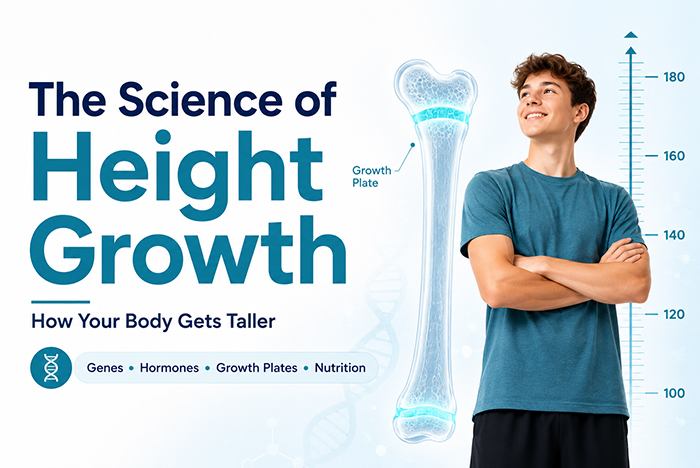
How does the human body actually get taller? The short answer: a tightly choreographed process involving genes, hormones, growth plates, and nutrition — running mostly in the background until your growth plates close in your late teens or early twenties. Here's the science in plain English, with sources from NIH MedlinePlus, KidsHealth, and Cleveland Clinic.
Key Takeaways
- Genetics account for roughly 80% of your final height. The other ~20% comes from nutrition, sleep, hormones, and overall health during the growing years.
- Height increases happen at the growth plates (epiphyseal plates) — thin layers of cartilage near the ends of long bones.
- Four hormone systems drive the process: human growth hormone (HGH), IGF-1, thyroid hormones, and sex hormones.
- Most of your lifetime height gain happens in two windows: rapid infant growth (0–2 years) and the puberty growth spurt (~10–16 for girls, ~12–18 for boys).
- Once growth plates fuse — typically by 14–17 in girls and 16–19 in boys — natural bone lengthening stops for good.
What Actually Determines Your Height
Height is one of the most studied human traits in genetics. Large-scale studies, including a 2022 analysis of more than five million people, have identified over 12,000 genetic variants that influence adult height — confirming that height is shaped by hundreds of genes working together, not just one or two.
Those genes set the ceiling. Whether you reach that ceiling depends on what happens during childhood and adolescence:
- Nutrition — enough protein, calcium, vitamin D, and total calories to build bone and tissue.
- Sleep — most growth hormone is released during deep sleep, especially in the first few hours.
- Hormonal health — functional pituitary, thyroid, and (during puberty) reproductive hormones.
- General health — chronic illness, malnutrition, and prolonged stress in childhood can blunt final height.
This is why average heights have climbed in many countries over the past century. The genes didn't change. Nutrition, healthcare, and living standards did.
The Growth Cascade: Three Systems That Make It Happen
Height growth isn't one event — it's a chain. The brain signals the pituitary, the pituitary signals the liver, and the liver signals the bones. Each link has to work for the next one to do its job.
Pituitary & HGH
The hypothalamus signals the pituitary gland, a pea-sized structure at the base of the brain, to release human growth hormone (HGH).
HGH levels surge during deep sleep and intense exercise, which is why those two habits matter for kids and teens still growing.
Liver & IGF-1
HGH travels through the bloodstream and reaches the liver, which produces insulin-like growth factor 1 (IGF-1) in response.
IGF-1 is the messenger that actually tells bone cells to multiply. Most of HGH's growth effects happen through IGF-1, not HGH directly.
Growth Plates
IGF-1 reaches the growth plates — cartilage layers near the ends of long bones — and triggers chondrocytes (cartilage cells) to divide.
New cartilage forms, hardens into bone, and the long bones lengthen. This is where every inch of height growth literally happens.
A fourth system runs in parallel: thyroid hormones are needed for normal bone growth, and during puberty, sex hormones (estrogen and testosterone) drive the adolescent growth spurt — and eventually shut growth down by closing the plates.
Growth Plates: Where the Inches Come From
Long bones — the femur, tibia, humerus, and others — don't grow from the middle. They grow at the ends, in a narrow band of cartilage called the epiphyseal plate, or growth plate. Each long bone in a child's body has one near each end.
The process inside a growth plate runs in four zones:
- Resting zone — reserve cartilage cells sit ready.
- Proliferative zone — cells multiply rapidly, pushing the bone longer.
- Hypertrophic zone — cells enlarge and start the transition to bone.
- Ossification zone — cartilage hardens into new bone, extending the shaft.
This conveyor belt runs continuously through childhood and accelerates during puberty. When sex hormones — particularly estrogen, in both girls and boys — reach a high enough level, the plates begin to fuse. The cartilage is fully replaced by bone, the zones disappear, and that bone can no longer lengthen.
The Five Stages of Human Growth
Height gain isn't a steady line from birth to adulthood. It happens in distinct phases, each with its own pace and dominant driver.
- Infancy (0–12 months): the fastest growth period of human life. Babies typically add about 10 inches (25 cm) in their first year, driven mostly by nutrition rather than HGH.
- Toddler years (1–3 years): growth slows but stays brisk — around 3 to 5 inches per year. HGH starts taking the lead role.
- Mid-childhood (3 years to puberty): a steady ~2 inches (5 cm) per year. This is the longest phase and the most predictable.
- Puberty growth spurt: the second-fastest window. Girls peak around ages 11–12 and gain about 3 inches a year at the peak; boys peak around 13–14 and gain about 4 inches a year. Sex hormones drive the spurt and eventually end it.
- Late teens: growth slows sharply, then stops as the plates close. Most girls finish growing by 14–16, most boys by 16–18, with some still gaining small amounts into the late teens.
The Building Blocks: Nutrients That Matter Most
Bone is living tissue. To extend a bone, the body needs raw materials — and chronic shortages of any one of them can blunt final height. The Academy of Nutrition and Dietetics and the NIH Office of Dietary Supplements consistently flag these as the heavy lifters:
- Protein — supplies amino acids for the bone matrix and stimulates IGF-1. Found in dairy, eggs, fish, poultry, beans, and tofu.
- Calcium — the dominant mineral in bone tissue. Sources: milk, yogurt, fortified plant milks, leafy greens, sardines.
- Vitamin D — required for the body to absorb calcium. Sunlight is the largest natural source; foods include fatty fish and fortified milk.
- Zinc — even mild zinc deficiency in children is linked to slowed growth. Sources: meat, shellfish, legumes, seeds.
- Iron — needed for oxygen delivery to growing tissues. Sources: red meat, poultry, lentils, fortified cereals.
Caloric adequacy matters too. A child who eats clean but undereats overall won't grow optimally — the body deprioritizes growth when energy is scarce.
Lifestyle Factors That Help (or Hurt)
Beyond food, four daily habits show up repeatedly in the research as either supporting or quietly blunting growth:
- Sleep — about 70% of daily HGH release happens during deep, slow-wave sleep, mostly in the first few hours after falling asleep. Teens routinely sleeping under 7 hours are short-changing this window.
- Physical activity — weight-bearing exercise and stretching support bone density and posture. Sports involving jumping (basketball, volleyball) and hanging (gymnastics, monkey bars) don't add extra inches, but they do support healthy bone development.
- Smoking and heavy alcohol use during the teen years — both have been associated with shorter adult height, likely via hormonal disruption and reduced nutrient absorption.
- Chronic stress and untreated illness — prolonged cortisol elevation suppresses growth. Chronic conditions like celiac disease or untreated thyroid issues can also stunt growth if missed.
When Growth Stops — and Why
The end of growth is not a calendar event. It's a biological one: growth plate fusion. As puberty winds down, sex hormones — especially estrogen, in both sexes — reach levels that drive the cartilage in the plates to fully ossify. Once that's done, the bone is a single piece, and it cannot get longer.
The typical timeline:
- Girls: growth plates generally close between ages 14 and 17, usually within 1–2 years after their first menstrual period.
- Boys: plates close later, generally between 16 and 19, with a few continuing into the early 20s.
The only way to confirm whether plates are still open in a specific person is an X-ray (a bone age scan), which a pediatrician or endocrinologist can order if there's a clinical reason. Once the plates are fused, no diet, exercise, or supplement can reopen them — that's a settled point in the medical literature.
Bottom Line
Human height is roughly 80% genetics and 20% environment. The genetic part is set. The environmental part isn't — and it makes the difference between reaching your genetic ceiling and falling short of it. For kids and teens still in their growing window, the playbook is unglamorous but well established: eat enough of the right nutrients, sleep 8–10 hours a night, stay active, and address any chronic health issues early. There's no shortcut, but there's also no mystery — just biology doing what biology does.
Watch on YouTube ↗❓ Frequently Asked Questions
At what age does height growth stop?
It depends on growth plate closure, not a fixed age. Most girls stop growing between 14 and 17, typically 1–2 years after their first period. Most boys stop between 16 and 19, with some adding small amounts into the early 20s. The only way to know an individual's status is a bone age X-ray.
Can you grow taller after growth plates close?
Not naturally. Once the epiphyseal plates fully fuse, the bone is a single piece and cannot lengthen. Adults can sometimes appear taller by 1–2 inches through better posture, core strength, and spinal decompression (yoga, hanging), but the underlying bone length is fixed.
How much of height is genetic vs. environmental?
Twin and family studies consistently estimate the heritability of height at around 80%. The remaining 20% reflects nutrition, sleep, hormonal health, chronic illness, and other environmental factors during the growing years.
Do hormones really make that much of a difference?
Yes. Children with untreated growth hormone deficiency typically end up significantly shorter than their genetic potential, while those with excess HGH before puberty can grow unusually tall. Thyroid and sex hormones play similarly outsized roles. Hormonal balance is essential, not optional.
Can supplements actually make a kid grow taller?
Supplements don't override genetics or reopen closed growth plates. What they can do is help fill nutritional gaps — calcium, vitamin D, protein, zinc — so a growing body has the raw materials to reach its genetic potential. A pediatrician's input is the right first step.
📚 References
- National Institutes of Health, MedlinePlus Genetics. Is height determined by genetics? https://medlineplus.gov/genetics/understanding/traits/height/
- Cleveland Clinic. Human growth hormone (HGH). https://my.clevelandclinic.org/health/articles/23309-human-growth-hormone-hgh
- American Academy of Orthopaedic Surgeons (OrthoInfo). Growth plate fractures. https://orthoinfo.aaos.org/en/diseases--conditions/growth-plate-fractures/
- KidsHealth from Nemours. Growth and your 13- to 18-year-old. https://kidshealth.org/en/parents/growth-13-to-18.html
- National Institutes of Health, Office of Dietary Supplements. Calcium: Fact sheet for health professionals. https://ods.od.nih.gov/factsheets/Calcium-HealthProfessional/