How to Maximize Growth Hormone Naturally While You Sleep

Every teenager wants to know the secret to growing taller. They research exercises, track their diet, and try every tip they can find. But the single most powerful growth trigger available to them happens every single night — and most of them are accidentally sabotaging it. Sleep isn't just rest. It's when your body does the actual work of growing.
Key Takeaways
- The largest daily pulse of human growth hormone (HGH) is released during slow-wave (deep) sleep — usually within the first 1.5–2 hours after falling asleep.
- Teens 13–17 need 8–10 hours of sleep; consistently falling short — even by 90 minutes — can meaningfully reduce GH output over time.
- Screens, caffeine, a warm room, and evening stress are the four biggest disruptors of deep sleep — and all four are fixable tonight.
- Sleeping flat on your back (or on your side) supports spinal decompression; stomach sleeping works against it.
- Nutrition, exercise timing, and a consistent wind-down routine all compound with sleep quality — none of them work as a substitute for it.
The Science of Growth Hormone Release During Sleep
Here's what's actually happening while you're unconscious. Growth hormone is released in pulses throughout the day, but the biggest and most important pulse occurs during slow-wave sleep (SWS) — also called deep sleep or Stage 3 NREM sleep. This typically happens within the first few hours after falling asleep.
Research published in the Journal of Clinical Endocrinology & Metabolism has shown that slow-wave sleep accounts for the majority of total daily GH secretion in healthy adolescents. In practical terms: if you're not reaching deep sleep, or not staying asleep long enough to cycle through it multiple times, you're leaving a significant amount of growth hormone on the table every single night. For more on how this hormone drives growth outside of sleep too, see Human Growth Hormone (HGH) and Height.
What disrupts deep sleep?
- Late-night screen time (blue light suppresses melatonin, the hormone that initiates sleep)
- Irregular sleep schedules that confuse your circadian rhythm
- Caffeine consumed in the afternoon or evening
- Sleeping in a warm room (core body temperature needs to drop to enter deep sleep)
- High stress levels, which elevate cortisol — the hormone that directly suppresses GH release
Fix the sleep, and you fix the hormone. It really is that direct.
▶ Watch: How to Boost Your Growth Hormone with Sleep | Dr. Gina Poe & Dr. Andrew Huberman
Watch on YouTube ↗How Much Sleep Do You Really Need?
| Age Group | Recommended Sleep | GH Release Window |
|---|---|---|
| 10–12 years | 9–11 hours | First 2 hours after sleep onset |
| 13–17 years | 8–10 hours | First 1.5–2 hours of deep sleep |
| 18–21 years | 7–9 hours | Decreases slightly with age |
| 22–25 years | 7–9 hours | Lower GH output than teen years |
The teen years represent peak GH production. That 8–10 hour window isn't just a recommendation — it's the period during which the body is most primed to release growth hormone in significant quantities. Shortchanging it by even 90 minutes consistently can meaningfully reduce that output over time. Not sure how your own sleep habits measure up? Our Sleep Needs Calculator by Age gives a quick, personalized target.
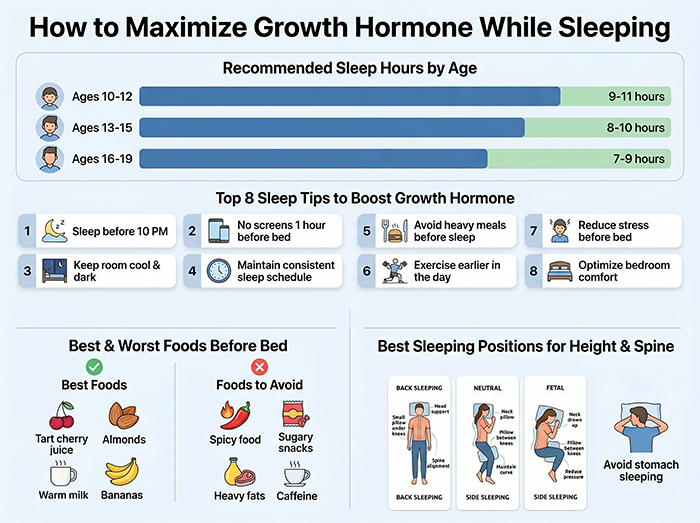
10 Proven Ways to Boost Growth Hormone Through Better Sleep
Lock In a Consistent Sleep Schedule
Go to bed and wake up at the same time every day — including weekends. Your circadian rhythm operates like clockwork, and consistency is what keeps it accurate. Irregular schedules fragment deep sleep cycles and reduce GH pulse intensity.
Eliminate Screens 60–90 Minutes Before Bed
Blue light from phones, tablets, and laptops suppresses melatonin production by up to 50%, according to Harvard Medical School research. No melatonin means delayed sleep onset and reduced time in slow-wave sleep. Put the phone down. It can wait.
Keep Your Bedroom Cool
Core body temperature needs to drop 1–2°F to initiate and maintain deep sleep. The ideal bedroom temperature is between 65–68°F (18–20°C). A warm room isn't just uncomfortable — it actively prevents the deep sleep stages where GH is released.
Go Dark
Even low levels of light during sleep can suppress melatonin. Blackout curtains or a sleep mask are simple, inexpensive fixes that make a noticeable difference in sleep depth.
Cut Caffeine After 2 PM
Caffeine has a half-life of 5–6 hours. That afternoon coffee or energy drink at 4 PM still has half its caffeine content active in your system at 9 PM. It doesn't just make it harder to fall asleep — it reduces time spent in deep sleep even when you do.
Exercise Earlier in the Day
Physical activity increases GH release both during exercise and during the subsequent night's sleep. However, vigorous exercise within 2–3 hours of bedtime raises core body temperature and cortisol levels, which can delay sleep onset. Morning or afternoon workouts are ideal. Read more: Best Height Growth Exercises for Teenagers.
Manage Stress Before Bed
Cortisol and growth hormone have an inverse relationship — when one goes up, the other comes down. High evening stress means high cortisol means blunted GH release. Simple wind-down habits like light stretching, journaling, or slow breathing exercises can meaningfully lower cortisol before sleep.
Don't Eat a Heavy Meal Right Before Bed
Eating a large meal — especially one high in carbohydrates or sugar — within 2–3 hours of sleep triggers an insulin spike. Elevated insulin suppresses GH release. Keep the pre-bed window light.
Get Morning Sunlight
Natural light exposure in the morning helps anchor your circadian rhythm, which in turn improves sleep timing and depth at night. Even 10–15 minutes outside within an hour of waking makes a measurable difference.
Consider a Short Relaxation Ritual
A consistent pre-bed routine signals the nervous system that sleep is coming. This can be as simple as 10 minutes of light stretching, a warm shower, or quiet reading. Over time, these cues become automatic triggers for faster sleep onset and deeper sleep quality.
Best Foods to Eat Before Bed — and What to Avoid
✅ Eat These
- A small handful of nuts (almonds, walnuts) — contain melatonin and magnesium, both of which support sleep quality.
- Tart cherry juice — one of the few natural sources of melatonin; small studies show it improves sleep duration.
- A light protein snack — like a boiled egg or small portion of Greek yogurt; protein supports overnight tissue repair without triggering an insulin spike.
- Chamomile tea — contains apigenin, a compound that binds to receptors in the brain associated with relaxation.
🚫 Avoid These
- Sugary snacks or desserts — spike insulin, which suppresses GH.
- Caffeinated drinks — disrupts sleep architecture even when you feel like it's not affecting you.
- Heavy, greasy meals — require significant digestion that keeps the body active during sleep.
- Alcohol — fragments sleep cycles and significantly reduces slow-wave sleep, even in small amounts.
For a broader list of growth-supporting ingredients beyond the pre-bed window, see Foods to Boost Growth Hormone.
Ideal Sleeping Positions for Height Growth
Sleeping position matters more than most people think — not just for comfort, but for spinal health and decompression.
On Your Back
Flat on your back without a pillow, or with a very thin one. This allows the spine to fully decompress overnight in its natural alignment. A thick pillow pushes the neck into flexion, compressing the upper vertebrae during the hours they should be recovering.
On Your Side
Side sleeping with a pillow between the knees keeps the spine in neutral alignment and prevents the hips from rotating, which can create lower back compression.
On Your Stomach
Forces the neck into rotation for hours at a time and creates significant lumbar compression. Over time, it negatively affects both spinal health and posture — both of which influence how tall you stand.
Sleep Routine Checklist for Teenagers
Use this every night:
Print it out. Put it on your wall. Check it off. The habit builds faster than you'd expect.
A Note on Natural Growth Support
A lot of teenagers who are serious about maximizing their growth take a combined approach — optimizing sleep and exercise while also making sure their body has the nutrients it needs to actually build bone and tissue during those overnight growth windows.
One supplement many parents and teens turn to is NuBest Tall 10+ — a non-GMO growth support formula designed specifically for children and teenagers. It's formulated to complement the kind of healthy sleep and lifestyle habits covered in this article, not replace them. If you're already doing the work and want to make sure nutrition isn't the missing piece, it's worth looking into.
Bottom Line
You don't need an expensive program or complicated protocol to maximize your growth hormone output. You need consistent, high-quality sleep — and the habits that protect it. Start with these tonight:
- Set a fixed bedtime and stick to it
- Put your phone in another room an hour before sleep
- Lower your room temperature
- Skip the late-night snacks
Small changes. Consistent nights. Over months, the results compound in ways that are genuinely measurable. Your body already knows how to grow. Give it the sleep it needs, and get out of the way.
❓ Frequently Asked Questions
When exactly does growth hormone get released during sleep?
The biggest GH pulse happens during slow-wave (deep) sleep — typically within the first 1.5–2 hours after falling asleep. This is why sleep quality matters as much as duration.
How many hours of sleep does a teenager actually need for height growth?
8–10 hours is the recommended range for teens 13–17. Consistently sleeping less than 7 hours noticeably reduces GH output over time.
Does sleeping position really affect height?
It affects spinal decompression and posture, which influence how tall you actually stand. Sleeping flat on your back without a thick pillow is the best position for overnight spinal recovery.
What's the worst thing I can do before bed if I want to grow taller?
Staying on your phone until midnight. Blue light suppresses melatonin, delays deep sleep onset, and directly reduces the GH surge your body is trying to produce.
Can stress really stop me from growing?
Yes — chronically high cortisol directly suppresses growth hormone release. Managing evening stress isn't just good for mental health; it's a legitimate part of supporting height growth.
Is it okay to eat before bed if I'm trying to grow taller?
A light snack is fine — something small with protein or natural melatonin like a handful of nuts. Avoid heavy meals or sugary foods within 2–3 hours of sleep, as the insulin spike suppresses GH release.
📚 References
- Van Cauter, E., & Copinschi, G. (1996). Physiology of growth hormone secretion during sleep. Journal of Pediatric Endocrinology & Metabolism. https://pubmed.ncbi.nlm.nih.gov/8627466/
- Takahashi, Y., et al. (1968). Growth hormone secretion during sleep. Journal of Clinical Investigation. https://pmc.ncbi.nlm.nih.gov/articles/PMC297368/
- Healthline. (2023). 10 ways to boost human growth hormone (HGH) naturally. https://www.healthline.com/nutrition/11-ways-to-increase-hgh
- Medical News Today. (2023). Ways to increase HGH. https://www.medicalnewstoday.com/articles/ways-to-increase-hgh
- KidsHealth. (n.d.). Growth and your 13- to 18-year-old. https://kidshealth.org/en/teens/growth-13-18.html
- Gunter, K. B., et al. (2008). Impact exercise increases BMC during growth: An 8-year longitudinal study. Journal of Bone and Mineral Research. https://pmc.ncbi.nlm.nih.gov/articles/PMC2679385/