There’s a moment most new parents know well. The pediatrician pulls out the growth chart, starts plotting dots, and suddenly you’re staring at a graph trying to figure out what “75th percentile” actually means for your child.
Is my baby growing normally? Are they too small? Too big? Right on track?
These are some of the most common — and most anxiety-producing — questions in early parenthood. And while every child grows at their own pace, having a solid understanding of average height and weight milestones gives you a reliable baseline to work from.
This guide breaks down what typical growth looks like from birth through age 3, what the numbers actually mean, and when it’s worth bringing a concern to your pediatrician.
Why Growth Tracking Matters in the Early Years
The first three years of life are the most rapid growth period a human being will ever experience. A baby roughly triples their birth weight by their first birthday and nearly doubles their birth length by age two. Nothing that happens later in life even comes close to this rate of physical development.
Tracking growth during this window matters for a few important reasons:
- It’s one of the earliest indicators of overall health. Consistent, steady growth generally signals that a child is getting adequate nutrition and developing normally. Sudden drops or plateaus can be early flags worth investigating.
- It helps catch nutritional gaps early. Underweight or underheight trends in infancy and toddlerhood can reflect feeding difficulties, digestive issues, or nutrient deficiencies that are far easier to address when caught early.
- It establishes a personalized baseline. Growth charts aren’t just about comparing your child to others — they’re about tracking your child’s individual curve over time. A consistent pattern at the 20th percentile is completely normal. A sudden drop from the 60th to the 20th percentile in a short window is worth a conversation with your doctor.
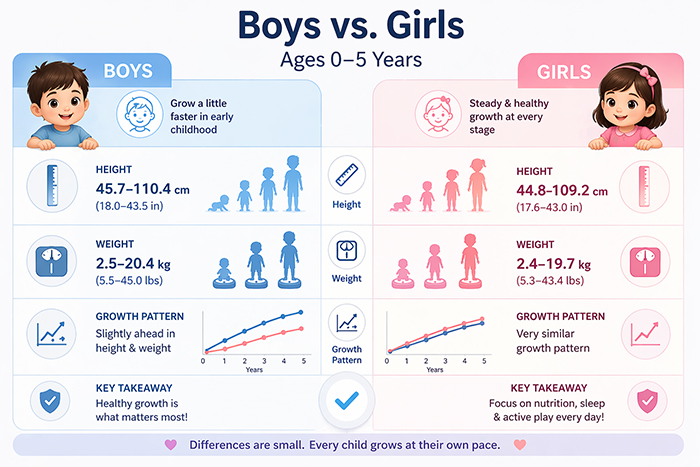
Average Height and Weight by Ages 0–5 (Boys vs Girls)
This chart is based on median (50th percentile) values derived from WHO and CDC growth data. Measurements are simplified for visualization and educational purposes.
⚠️ This content is for informational purposes only and should not be used as a substitute for professional medical advice. Always consult a qualified healthcare provider for growth concerns.
Understanding Growth Percentiles
This is where a lot of parents get tripped up.
A percentile ranking does not mean your child is ahead or behind. It simply means how your child compares to a reference population of the same age and sex.
A baby at the 50th percentile for weight is right at the middle — heavier than 50% of babies their age, lighter than the other 50%.
A baby at the 10th percentile isn’t underweight. It means they’re smaller than 90% of babies their age — which, for a child who has consistently tracked at the 10th percentile since birth, is completely normal for them.
What pediatricians pay the most attention to is the shape of the curve, not the number itself. A child who tracks steadily along their own percentile line — whether that’s the 5th or the 95th — is generally considered to be growing well. The concern arises when a child’s growth curve suddenly shifts significantly, either dropping or spiking, relative to their own established pattern.
Month-by-Month Growth: What to Expect
Birth to 3 Months
This is the fastest growth window of the entire first year. Most newborns lose a small amount of weight in the first few days after birth — typically 5–7% of their birth weight — as the body adjusts to life outside the womb. This is completely normal. By 10–14 days, most babies have returned to their birth weight and are gaining steadily.
From there, the average gain is roughly 1 to 1.5 ounces per day during the first three months. In terms of length, babies typically grow about 1 to 1.5 inches per month during this period.
3 to 6 Months
Growth remains rapid but starts to slow slightly from that initial burst. Weight gain typically averages around 1 to 1.25 ounces per day. By 4 months, most babies have doubled their birth weight — one of the classic developmental milestones pediatricians look for.
6 to 12 Months
The pace slows further. Average weight gain drops to roughly 3 to 5 ounces per week, and length increases by about half an inch per month. This is also when solid foods typically enter the picture, which can influence growth patterns as the digestive system adjusts.
12 to 24 Months
The transition from infancy to toddlerhood brings a noticeable slowdown. Many parents worry when their child’s appetite drops around age 1 — but this is normal. Growth rate is slowing, so the body simply doesn’t need as many calories relative to body size as it did in the first year.
During this period, toddlers gain roughly 5 pounds and grow about 4–5 inches over the full year.
24 to 36 Months
By age 2, most toddlers have settled into a fairly predictable growth pattern. The average gain through the third year of life is approximately 4–5 pounds and 2.5–3.5 inches. This more gradual, steady pace continues through most of early childhood until the next major growth acceleration — puberty.
Boys vs. Girls: Are There Differences?
Yes — though they’re relatively modest in the first two years.
At birth, boys tend to be slightly heavier and longer than girls on average. This gap remains fairly consistent through toddlerhood. The CDC and World Health Organization (WHO) maintain separate growth charts for boys and girls for this reason — using the wrong chart for your child’s sex would give you inaccurate percentile readings.
The more significant divergence happens later, around puberty, when the timing and intensity of growth spurts differ considerably between sexes. For babies and toddlers, the difference is real but not dramatic.
When Should You Be Concerned?
Most growth variations in early childhood are completely normal. But there are a few patterns worth flagging to your pediatrician:
Dropping significantly across percentile lines. If your child drops from the 60th percentile to the 20th over a short period — not gradually over years, but relatively quickly — that’s worth discussing.
Consistently below the 3rd percentile. This doesn’t automatically signal a problem, but it warrants closer monitoring and possible evaluation.
No weight gain over a 2–3 month period in infancy. In the first year especially, consistent forward progress matters.
Significant gap between height and weight percentiles. If a toddler is at the 70th percentile for height but the 10th for weight, a pediatrician may want to look more closely at nutritional intake or potential underlying issues.
That said — pediatricians exist for exactly this kind of monitoring. Growth chart conversations are a routine part of well-child visits for a reason. You don’t need to become an expert in percentile analysis. You just need to show up to those appointments consistently.
Tips for Supporting Healthy Growth in the Early Years
You don’t need to do anything complicated. The basics, done consistently, cover most of it:
- Prioritize responsive feeding. Whether breastfeeding, formula feeding, or a combination, feeding on demand in the early months supports both growth and healthy appetite regulation.
- Introduce solids at the right time. The American Academy of Pediatrics recommends starting solid foods around 6 months. Early introduction isn’t associated with faster growth and can cause digestive issues.
- Don’t stress the appetite fluctuations. Toddlers are notoriously inconsistent eaters. A day of barely eating followed by a day of eating everything in sight is completely normal — their bodies are self-regulating.
- Keep well-child visits. These appointments exist to catch exactly the kind of gradual changes that are hard to notice day-to-day. Don’t skip them, even when your child seems perfectly healthy.
- Watch sleep. Growth hormone is primarily released during deep sleep — even in infancy. Protecting sleep quality and duration matters from the very beginning.
In conclusion,
Growth charts can feel intimidating, but they’re really just a tool — a way of visualizing your child’s development over time in the context of broader population data.
The number that matters most isn’t the percentile. It’s the consistency of your child’s own curve.
A baby who tracks steadily at the 15th percentile from birth through toddlerhood is growing exactly as they should. A toddler who suddenly drops off their established curve is worth a conversation with a doctor — not a reason to panic, but a signal worth paying attention to.
Trust the process, keep the appointments, and remember: children have been growing without parental intervention for a very long time. Your job isn’t to engineer the outcome. It’s to provide the conditions — good nutrition, enough sleep, plenty of love — and let the biology do what it’s designed to do.
REFERENCES
Frequently Asked Questions
Most full-term newborns weigh between 5.5 and 8.8 pounds (2.5–4 kg). Anything within that range is generally considered healthy — your pediatrician will flag anything outside it at birth.
Completely normal. Most newborns lose 5–7% of their birth weight in the first few days as the body adjusts. By day 10–14, they're typically back to birth weight and gaining steadily.
Most babies double their birth weight by around 4 months and triple it by their first birthday. These are classic milestones pediatricians look for during well-child visits.
Your pediatrician handles this at every well-child visit — typically at 1, 2, 4, 6, 9, 12, 15, 18, and 24 months, then annually after that. You don't need to measure at home obsessively. Just keep those appointments.
It means they're smaller than 80% of kids their age — and that's perfectly fine if they've been consistently tracking there. Percentiles aren't grades. What matters is that your child follows their own curve over time.
Probably not. Appetite fluctuations in toddlers are completely normal — their growth rate is slowing down, so their calorie needs are lower relative to their size. As long as their growth curve stays consistent, erratic eating days are just part of the toddler experience.

Hello everyone, I’m Dr. Lily, a medical expert specializing in height enhancement with years of research experience and practical application of height-increasing methods, yielding promising results. I’ve launched a height growth blog as a personal platform to share knowledge and experiences gained throughout my journey of height improvement.