Human Growth Hormone (HGH) and Height: What Science Actually Says

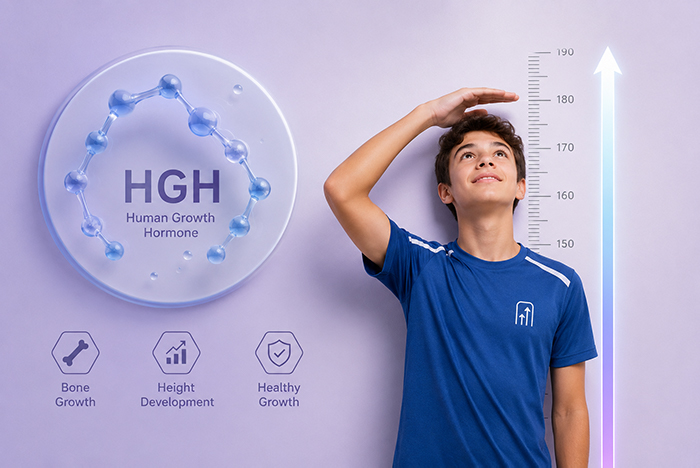
Human Growth Hormone (HGH) is the single most important hormone for height development — yet most people misunderstand what it actually does, when it peaks, and what genuinely raises or suppresses it. This guide covers the biology, the lifestyle factors that matter, and the clinical reality of HGH as a medical treatment.
Key Takeaways
- HGH is released in pulses — not continuously — with the largest pulse occurring during the first slow-wave sleep cycle, approximately 60–90 minutes after sleep onset.
- HGH does not directly elongate bone. It stimulates the liver to produce IGF-1, which acts on growth plate chondrocytes to drive longitudinal bone growth.
- Sleep, nutrition, physical activity, and stress management are the four modifiable lifestyle factors with the strongest evidence for supporting HGH output.
- Prescription HGH therapy is effective for children with confirmed GH deficiency and several other specific conditions — but has no proven benefit for height in children without a diagnosis.
- Supplements claiming to boost HGH do not contain actual HGH and have minimal evidence for meaningful GH elevation in healthy people.
What Human Growth Hormone Actually Does
HGH (also called somatotropin) is a 191-amino acid protein hormone produced by the anterior pituitary gland. Its role in height growth is indirect but essential: HGH does not act on bone tissue directly. Instead, it travels to the liver and stimulates the production of Insulin-like Growth Factor 1 (IGF-1) — the actual signal that reaches growth plate chondrocytes and drives bone elongation.
This two-step mechanism — GH → IGF-1 → bone growth — explains why serum IGF-1 levels are the more clinically useful marker for assessing growth hormone axis function than GH itself. GH is released in short pulses that are gone within minutes; IGF-1 reflects the integrated output of the GH axis over hours.
▶ Watch: What Triggers Human Growth Hormone (HGH)? — Dr. Berg
Watch on YouTube ↗Somatostatin — a hormone also produced by the hypothalamus — acts as the brake on this system, inhibiting GH release. Many lifestyle and nutritional factors that "boost HGH" work primarily by reducing somatostatin tone, not by directly stimulating the pituitary.
When HGH Peaks Across a Lifetime
HGH secretion follows a well-documented pattern across the lifespan. Understanding this pattern helps parents and teens prioritize interventions at the ages when they matter most.
HGH secretion is at its highest in the first months of life, supporting the extraordinary growth rate of infancy (20–25 cm in year one). Output remains high through toddlerhood, driving the 6–9 cm/year rate of early childhood. Sleep duration at this age is particularly important — infants and toddlers distribute GH pulses across multiple sleep periods, not just overnight.
GH output settles into a steady rhythm that supports the 5–7 cm/year juvenile growth rate. The overnight GH pulse consolidates into a single large release during the first slow-wave sleep cycle. This is the phase where consistent sleep habits, adequate protein, and calcium lay the nutritional foundation for the pubertal surge ahead.
Sex hormones dramatically amplify GH secretion — both the pulse amplitude and the pulse frequency increase. This is the physiological driver of peak height velocity (8–12 cm/year in boys, 7–8 cm/year in girls). IGF-1 levels reach their lifetime maximum during this phase. Any lifestyle factor that suppresses GH — chronic sleep deprivation, high sugar intake, alcohol, chronic stress — carries its highest cost during puberty.
After growth plates fuse, GH secretion drops significantly but does not disappear. GH continues to regulate body composition, muscle mass, bone density, and metabolic function throughout adult life. IGF-1 levels decline from their pubertal peak but remain physiologically active. Lifestyle factors still influence GH output at this age — sleep, exercise, and nutrition all remain relevant.
GH secretion declines at approximately 1–2% per year after age 30 in most adults. This somatopause contributes to the body composition changes of aging — reduced muscle mass, increased adiposity — but does not affect height, as growth plates are long fused. Prescription GH therapy in adults with confirmed GH deficiency improves body composition and quality of life but does not add height.
The Sleep Connection: Why the First 90 Minutes Matter Most
The relationship between sleep and GH is the most clinically important — and most commonly misunderstood — aspect of the hormone. GH is not released throughout sleep uniformly. The dominant pulse occurs during the first episode of slow-wave sleep (stage N3), typically 60–90 minutes after sleep onset, and accounts for 60–70% of total daily GH secretion.
GH release is triggered by sleep stage, not clock time. A teen who falls asleep at midnight enters slow-wave sleep at approximately 1:30 am and receives the GH pulse then. Delaying sleep onset — the primary effect of evening screen use — delays but does not eliminate the pulse. Cutting sleep short eliminates the later cycles and their smaller pulses.
Four Lifestyle Factors That Directly Affect HGH Output
Chronic sleep deprivation reduces slow-wave sleep disproportionately — a teen averaging 6.5 hours when they need 9 may be producing only 50–60% of their potential GH output. Phone use in the bedroom is the primary cause of sleep loss in children and teens, delaying melatonin onset by 45–90 minutes on average. The intervention: phone physically removed from the bedroom (not airplane mode), consistent sleep and wake time, and 60 minutes of dimmed light before bed. The dose-response between slow-wave sleep duration and GH output is linear — every additional 30 minutes of deep sleep meaningfully increases GH production.
Protein is the most important dietary variable for GH axis function. Adequate protein intake (1.0–1.6 g/kg/day depending on age and activity) supports IGF-1 production directly — studies show that protein restriction reduces IGF-1 levels independent of total caloric intake. High blood glucose suppresses GH secretion via somatostatin — a large sugary meal or soft drink before sleep blunts the overnight GH pulse. Caloric restriction and underweight status also suppress GH output, explaining why children with inadequate total energy intake grow poorly even when specific micronutrients appear adequate.
Physical exercise — particularly high-intensity and resistance exercise — triggers acute GH pulses through a separate pathway from sleep: the exercise-GH axis. This operates via reduced somatostatin tone during and after vigorous activity. The GH pulse from a vigorous exercise session peaks 15–30 minutes post-exercise and can be significant in magnitude. Weight-bearing exercise also directly stimulates bone formation through mechanical loading, independent of GH. Children and teens who are physically active consistently show higher IGF-1 levels and better height velocity than sedentary peers with comparable diets.
Cortisol and growth hormone move in opposite directions hormonally — cortisol elevation directly suppresses GH secretion and reduces IGF-1 levels. Chronic psychological stress — from academic pressure, family conflict, anxiety, or social difficulty — produces chronically elevated cortisol that measurably blunts GH output over time. This is the mechanism behind psychosocial short stature, a real clinical entity in which children in high-stress environments show growth faltering that reverses when the environment improves. Stress management is not peripheral to height optimization — it is central to it.
What Suppresses HGH — and by How Much
Clinical HGH Therapy: What It Is and Who It Is For
Prescription recombinant human growth hormone (rhGH) is a legitimate medical treatment for specific diagnosed conditions. It is administered by daily subcutaneous injection, requires monitoring by a pediatric endocrinologist, and costs $10,000–$40,000 per year. Understanding what it is — and what it is not — is important context for any family researching HGH.
▶ Watch: Should Short People Take Human Growth Hormone?
Watch on YouTube ↗For children without one of these diagnoses, rhGH therapy has no proven height benefit. The off-label use of HGH in healthy short children remains controversial — the cost, injection burden, and potential risks are significant, and average height gains in ISS (the most permissive indication) are modest.
HGH Supplements: What the Evidence Actually Shows
Supplements marketed as "HGH boosters," "growth hormone releasers," or "secretagogues" do not contain actual growth hormone — HGH is a 191-amino acid protein that is destroyed by digestion and cannot be delivered orally. What they typically contain are amino acids (arginine, lysine, ornithine), herbal extracts, and vitamins — with the following evidence base:
Intravenous arginine at pharmacological doses raises GH levels — this is actually used in clinical GH stimulation testing. Oral arginine supplements at typical doses (2–10 g) produce modest GH increases in some studies, particularly when combined with exercise. However, the magnitude of the effect is far smaller than the GH pulse from a single night of adequate sleep. No study has demonstrated that arginine supplementation improves height velocity in children.
A single small study found that oral GABA supplementation increased GH levels acutely, likely by reducing somatostatin tone. The study has not been adequately replicated, and no downstream effect on growth has been demonstrated. GABA does not cross the blood-brain barrier efficiently when taken orally in most people.
Growth plate fusion is an irreversible biological process driven by sex hormone-mediated epiphyseal ossification. No supplement, exercise, or nutritional intervention reopens fused growth plates. Any product making this claim is making a scientifically impossible assertion. These products are not regulated for efficacy and should be avoided.
Practical Summary: What Parents and Teens Can Actually Do
Based on the evidence, these are the interventions with the strongest support for maximizing HGH output during the growth years — in order of impact:
▶ Watch: Human Growth Hormone — 10 Ways to Boost Naturally
Watch on YouTube ↗No supplement approach meaningfully competes with optimizing sleep alone. The overnight GH pulse from a well-slept 13-year-old is orders of magnitude larger than anything a supplement can produce. Get the fundamentals right before considering any supplemental intervention.
❓ Frequently Asked Questions
Does HGH make you taller?
In children with open growth plates, adequate HGH is necessary for normal height growth — without it, bone elongation is significantly impaired. In children with GH deficiency, prescription HGH therapy produces substantial height gains. However, in children with normal GH levels, additional HGH does not increase height further, because the growth plate response is not limited by GH availability. The rate-limiting factor in well-nourished, normally-sleeping children is typically genetic, not hormonal.
What time of night is HGH released?
HGH is released based on sleep stage, not clock time. The largest pulse occurs approximately 60–90 minutes after sleep onset, during the first slow-wave sleep episode. A child who falls asleep at 9 pm receives this pulse around 10:30 pm. A child who falls asleep at midnight receives it around 1:30 am. The clock time is irrelevant — what matters is that sleep onset occurs and is not disrupted before slow-wave sleep is reached.
Can you increase HGH naturally?
Yes — within the limits of your pituitary capacity. The most effective natural interventions are: consistent adequate sleep (the dominant factor by a wide margin), regular vigorous exercise, protein-sufficient nutrition, and stress reduction. Intermittent fasting also acutely raises GH levels, though this is not recommended for growing children. No natural intervention approaches the magnitude of GH produced during normal sleep in a healthy child.
Is HGH safe for children?
Prescription rhGH is safe when administered under medical supervision for appropriate diagnoses. Side effects are generally mild at therapeutic doses — injection site reactions, fluid retention, and in rare cases pseudotumor cerebri. Long-term safety data from decades of clinical use in children is reassuring. However, unsupervised HGH use, black-market HGH, and HGH sourced outside medical channels carry significant risks including contamination, overdosing, and the consequences of suppressing endogenous GH production.
My child's IGF-1 is low — what does that mean?
Low IGF-1 in a child with growth concerns is a signal that warrants further evaluation by a pediatric endocrinologist — it does not automatically mean GH deficiency. IGF-1 can be low due to GH deficiency, but also due to protein malnutrition, liver disease, hypothyroidism, or chronic illness. A formal GH stimulation test (not just an IGF-1 level) is required to confirm or exclude GH deficiency. IGF-1 is a screening marker; stimulation testing is the diagnostic standard.
📚 References
- Van Cauter E, Plat L. Physiology of growth hormone secretion during sleep. Journal of Pediatrics. 1996;128(5 Pt 2):S32–37. pubmed.ncbi.nlm.nih.gov/8627466
- Hoppe C, et al. High intakes of skimmed milk, but not meat, increase serum IGF-1 and IGFBP-3 in eight-year-old boys. European Journal of Clinical Nutrition. 2004;58(9):1211–1216. pubmed.ncbi.nlm.nih.gov/15054426
- Grimberg A, et al. Guidelines for growth hormone and insulin-like growth factor-I treatment in children and adolescents. Journal of Clinical Endocrinology and Metabolism. 2016;101(5):1460–1483. pubmed.ncbi.nlm.nih.gov/26943180
- Frias J, et al. Effects of ethanol on growth hormone secretion in adolescents. Journal of Pediatrics. 2000;136(2):192–197. pubmed.ncbi.nlm.nih.gov/10657824
- Crompton R, et al. Exercise and growth hormone secretion — the exercise-GH axis. Sports Medicine. 2007;37(4–5):412–416.