Best Height Growth Exercises for Teenagers

Most teens assume height is completely out of their hands. Your parents are a certain height, so you will be too. End of story. That's not the whole picture. Genetics set the ceiling — but exercise, sleep, and nutrition determine how close you actually get to it. For teenagers between 13 and 19, when growth plates are still open and growth hormone is firing at its highest levels, consistent movement can make a genuine difference.
Key Takeaways
- Exercise doesn't create height out of nowhere — it helps your body reach the height it was already genetically capable of.
- High-intensity and resistance movement spikes growth hormone (HGH), the primary driver of bone elongation during adolescence.
- The spine makes up roughly 35% of total height — spinal decompression exercises can recover space lost to daily compression.
- A full routine takes just 25–35 minutes, but consistency over months matters far more than intensity over days.
- Growth plates typically begin closing between ages 16–21 — the window is real, but it doesn't stay open forever.
The Science Behind Exercise and Height Growth
Here's what's actually happening inside a growing body when it moves.
Growth hormone spikes during exercise. Research consistently shows that physical activity — especially high-intensity and resistance-based movement — triggers a significant release of human growth hormone (HGH). HGH is the primary driver of bone elongation during adolescence. More movement means more of it circulating in your system. For the full picture on how HGH works — including the nighttime side of the equation — see Exercise and Its Effect on Height Growth.
The spine is more flexible than most people realize. Your vertebral column accounts for roughly 35% of your total height. Between each vertebra sits a cartilage disc that compresses under gravity throughout the day. Targeted stretching and decompression exercises restore that lost space — and over time, can contribute to measurable improvements in standing height.
Growth plates respond to mechanical stimulation. The growth plates — soft cartilage zones near the ends of your long bones — are still active during the teen years. Controlled impact and stretching keep them stimulated and healthy, supporting the bone-lengthening process that's already underway.
Bottom line: exercise doesn't create height out of nowhere. It helps your body reach the height it was already capable of.
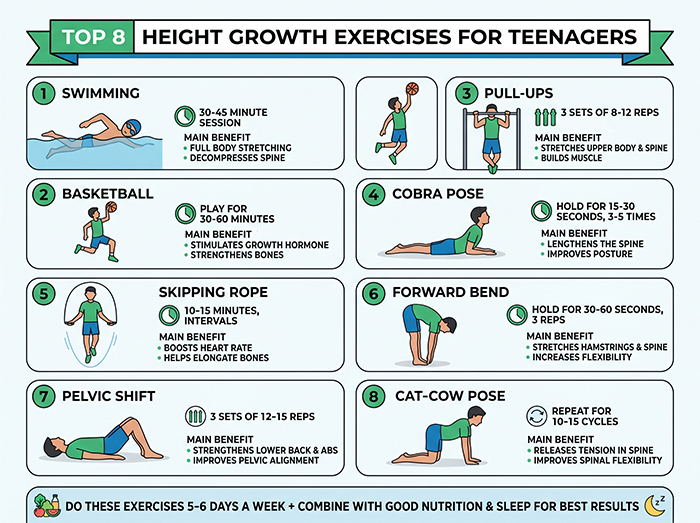
Top 8 Most Effective Height-Boosting Exercises
A few of these pair naturally with gentle, flow-based movement — if you want a complementary stretching sequence, see Yoga Poses for Height Growth.
Dead Hang
3–5 sets · 20–30 secHow to do it: Grip an overhead bar with both hands shoulder-width apart. Let your body hang completely relaxed — legs straight, shoulders loose.
Benefits: Directly decompresses the spine by reversing gravity's daily compression on vertebral discs.
💡 Do this first thing in the morning when your spine is freshest.
Jump Rope
3 rounds · 3–5 minHow to do it: Standard two-foot jump at a moderate, steady pace. Land softly on the balls of your feet.
Benefits: Creates brief, repeated impact forces through the legs and spine — a stimulus strongly linked to bone density and growth plate activity. Also one of the most effective exercises for spiking HGH.
💡 Consistent daily sessions beat long occasional ones every time.
Cobra Stretch
3 sets · 15–20 sec holdHow to do it: Lie face down with palms flat under your shoulders. Press up slowly, arching your back and lifting your chest toward the ceiling. Hold, then lower.
Benefits: Strengthens and lengthens the thoracic and lumbar spine. Builds the postural muscles that keep you standing tall throughout the day.
💡 Move slowly. This isn't a race — controlled movement gets more out of the stretch.
Cat-Cow Stretch
10–15 cyclesHow to do it: Start on all fours. Inhale and drop your belly toward the floor, lifting your head and tailbone (cow). Exhale and round your spine toward the ceiling, tucking your chin and pelvis (cat).
Benefits: Mobilizes every segment of the spine and hydrates the intervertebral discs — maintenance for the cartilage that makes up a significant portion of your height.
💡 Sync your breathing with the movement for maximum spinal mobility.
Pelvic Tilt
3 sets · 10 repsHow to do it: Lie on your back with knees bent and feet flat. Flatten your lower back against the floor by tightening your core and tilting your pelvis slightly upward. Hold 5 seconds, release.
Benefits: Corrects anterior pelvic tilt — extremely common in teens who sit for long hours — which compresses the lumbar spine and visually shortens the torso.
💡 If you spend most of your day sitting, do this every single evening without skipping.
Forward Spine Stretch
3–5 holds · 15–20 secHow to do it: Sit on the floor with legs straight out in front. Reach both arms forward as far as possible toward your toes. Hold the furthest point.
Benefits: Stretches the entire posterior chain — hamstrings, lower back, thoracic spine. Tight hamstrings pull the pelvis down and compress the lumbar spine, quietly stealing height.
💡 Never bounce. Hold the stretch steady for the full duration.
Swimming (or Dry Land Swimming)
3 sets · 30 sec (or 15 min pool)How to do it: If pool access isn't available, lie face down and alternate lifting opposite arm and leg off the ground, as if swimming freestyle. Hold each extension for 2–3 seconds.
Benefits: Full-body elongation with zero spinal compression. Consistently cited in sports medicine research as one of the best activities for adolescent skeletal development.
💡 Focus on fully extending each arm and leg — the stretch is the point, not the speed.
Wall Stretch
3 sets · 20–30 secHow to do it: Stand with your back flat against a wall — heels, glutes, upper back, and head all touching. Rise onto your toes and reach both arms straight up, trying to create maximum length from floor to fingertips. Hold.
Benefits: Trains postural alignment and actively lengthens the spine under your own body weight. Also builds the muscle memory to stand tall without thinking about it.
💡 Do this daily. Over a few weeks, this upright position starts to feel natural — and you'll carry it everywhere.
Weekly Workout Routine for Teenagers
| Day | Focus | Exercises |
|---|---|---|
| Monday | Full Routine | All 8 exercises |
| Tuesday | Active Recovery | Jump rope (5 min) |
| Wednesday | Spine Focus | Dead hang, Cobra, Cat-cow, Forward stretch |
| Thursday | Rest | Light walking |
| Friday | Full Routine | All 8 exercises |
| Saturday | Fun Movement | Swimming, basketball, sports |
| Sunday | Rest | Full recovery |
Total time per full session: 25–35 minutes. That's it.
Common Mistakes Teenagers Make
Doing it for two weeks then quitting. Height development is slow and cumulative. The teens who see results are the ones who show up for months, not days.
Only stretching, never jumping. Flexibility work is important — but without the compound movements that spike growth hormone, like jump rope and swimming, you're getting only half the benefit.
Terrible posture the other 23 hours. Thirty minutes of spine work doesn't cancel out eight hours of slouching over a phone. Posture has to become an all-day awareness, not just a gym habit.
Skipping rest days. Growth happens during recovery, not during the workout. Two to three rest days per week isn't optional — it's part of the program.
Expecting results in two weeks. Postural improvements show up in 4–6 weeks. Actual height changes from skeletal growth take 3–6 months minimum. Patience isn't just a virtue here — it's required.
Combine Exercise with Nutrition and Sleep for Maximum Results
Exercise is the engine. Sleep and nutrition are the fuel.
The majority of daily growth hormone is released during deep sleep — specifically during slow-wave sleep cycles. Teens need 8–10 hours. Cutting that short doesn't just cause fatigue; it directly reduces the hormonal environment that makes growth possible. Protect those hours like they matter, because they do.
Bones need Calcium, Vitamin D3, and Vitamin K2 to grow and mineralize properly. These aren't optional micronutrients — they're structural requirements. Dairy, leafy greens, eggs, and fatty fish cover a lot of this ground. For teens with inconsistent diets or busy schedules, targeted nutrition support can help fill the gaps during the years that matter most.
Stand against a wall — heels, glutes, upper back, and head all touching. That's neutral alignment. Practice holding it for 60 seconds daily until it becomes your default. Poor posture doesn't just look bad; it physically compresses the spine and can subtract a full inch or more from standing height.
These three factors don't replace exercise. They multiply it. Read more: How to Maximize Growth Hormone Naturally While You Sleep.
A Note on Natural Growth Support
A lot of teenagers — and their parents — combine consistent exercise and healthy habits with premium growth supplements to make sure nothing is getting missed nutritionally during these critical years.
One option many families trust is NuBest Tall, which is specifically formulated to support bone growth and overall development in children and teenagers. It's not a replacement for the habits in this article — it's something many parents use alongside them to cover their nutritional bases during the growth window.
Worth looking into if you want to make sure your teen's body has everything it needs to grow.
Bottom Line
Here's the honest truth: your growth window doesn't stay open forever. For most teenagers, the growth plates begin closing between 16 and 21 — see Can You Grow Taller After 19? for what that means in practice. Once they close, skeletal height is largely set.
But right now? The window is open. Twenty-five minutes a day. Eight to ten hours of sleep. The right nutrients. Consistent posture. These aren't complicated asks — they're the basics done right, during the years when the basics actually move the needle.
You don't need a perfect routine. You need a consistent one. Start tonight. Your future self will be glad you did.
❓ Frequently Asked Questions
Can exercise actually help me grow taller as a teenager?
Yes — exercise stimulates growth hormone release and keeps your growth plates active. It won't override genetics, but it helps you reach your actual potential.
How long does it take to see results from height growth exercises?
Posture improvements show up within 4–6 weeks. For measurable height changes, expect 3–6 months of consistent effort.
How many days a week should I do this routine?
5 days a week is ideal — full routine on 3 days, lighter movement on 2, and 2 full rest days. Recovery is part of the process.
What's the single best exercise for growing taller?
Dead hangs are the most effective for spinal decompression. Pair them with jump rope for growth hormone stimulation and you've covered the most ground efficiently.
Can I still grow taller at 17 or 18?
Possibly — growth plates in boys don't fully close until 18–21. Even if skeletal growth is slowing, posture correction alone can add 1–2 visible inches.
Do I need equipment to follow this routine?
Minimal. A pull-up bar for dead hangs and a jump rope cover the most important exercises. Everything else is bodyweight on the floor.
📚 References
- NuBest Nutrition. (n.d.). Top six increase height exercises. https://www.nubest.com/blogs/growth-tips/top-six-increase-height-exercises-135794
- Gunter, K. B., et al. (2008). Impact exercise increases BMC during growth: An 8-year longitudinal study. Journal of Bone and Mineral Research. https://pmc.ncbi.nlm.nih.gov/articles/PMC2679385/
- Malina, R. M. (1994). Physical activity and growth in children and adolescents. Medicine & Science in Sports & Exercise. https://pubmed.ncbi.nlm.nih.gov/8052116/
- Medical News Today. (2023). How to increase height: Factors that influence growth. https://www.medicalnewstoday.com/articles/327514
- Healthline. (2023). Is it possible to increase your height after 18? https://www.healthline.com/nutrition/increasing-height